

Knowi supports HIPAA-compliant deployments for embedded healthcare analytics through on-premise installation, SOC 2 Type II certification, role-based and row-level security, encrypted embedding, and Private AI that keeps all data processing inside the organization’s infrastructure.
TL;DR
- No software product is “HIPAA certified” because HIPAA does not certify technology. Compliance depends on how the platform is deployed, configured, and governed.
- Knowi supports on-premise deployment so protected health information never leaves the organization’s infrastructure.
- The cloud-managed deployment is SOC 2 Type II certified with encryption, access controls, and audit logging.
- Row-level security isolates patient data between tenants in multi-tenant healthcare SaaS applications.
- Private AI runs entirely inside the deployment with no data sent to external AI providers.
- Encrypted URL embedding uses AES encryption with time-based token expiration to prevent unauthorized dashboard access.
- Healthcare data breaches cost more than $7 million per incident on average according to the IBM Cost of a Data Breach Report.
Table of Contents
Why “Is It HIPAA Compliant?” Is the Wrong Question
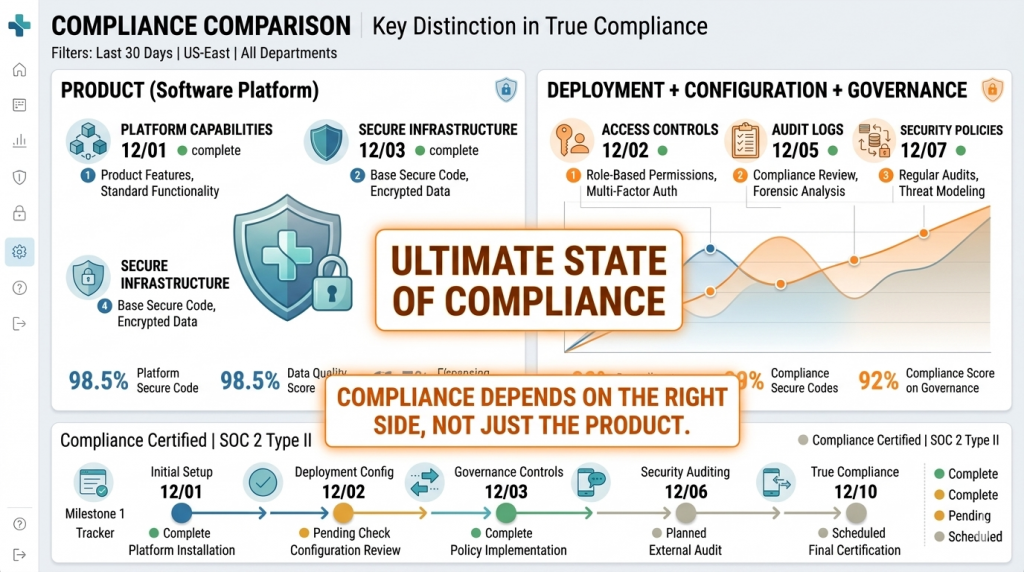
HIPAA does not certify or approve software products. The HIPAA Security Rule requires covered entities and business associates to implement administrative, physical, and technical safeguards when handling electronic protected health information.
Compliance is determined by how a system is deployed, configured, and operated, not by a label on the product. A platform can provide all the controls needed for HIPAA compliance while the organization still fails an audit because of misconfigured access policies or missing audit logs.
The right question is whether an analytics platform provides the technical controls, deployment options, and administrative safeguards required to support a HIPAA-compliant implementation.
How Knowi Supports HIPAA-Compliant Healthcare Deployments
On-premise deployment
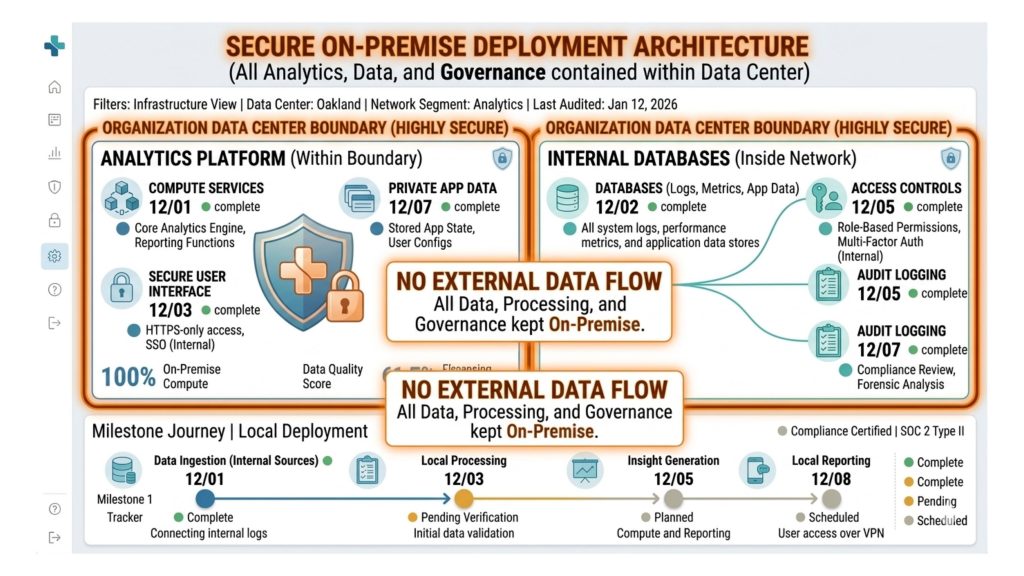
Knowi can be installed on-premise using Docker, Kubernetes, or native installation. When deployed inside the organization’s data center, PHI never leaves the infrastructure boundary.
This eliminates the need to transmit patient data to a third-party cloud for analytics processing. The organization controls physical access, network boundaries, encryption keys, and patch management.
SOC 2 Type II certification
The cloud-managed deployment is SOC 2 Type II certified. This certification validates that security controls for data protection, access management, and operational procedures are in place and operating effectively over time.
SOC 2 Type II is one of the most common security frameworks healthcare organizations evaluate when assessing analytics vendors.
Role-based and row-level security
Knowi enforces access controls at multiple levels. Role-based access control determines which dashboards, datasets, and features a user can access. Row-level security filters query results so each user or tenant only sees the records they are authorized to view.
In multi-tenant healthcare SaaS products, row-level security prevents cross-tenant PHI exposure. A single embedded dashboard can serve multiple healthcare organizations while keeping patient data completely isolated.
Encrypted embedding
Knowi’s embedded analytics supports three integration methods: URL embedding, encrypted URL embedding with AES encryption and time-based token expiration, and JavaScript API embedding.
The encrypted URL method is the most relevant for healthcare. Tokens expire after a configurable time window, preventing unauthorized access to dashboards that display PHI. Embedding parameters are encrypted so users cannot modify filters or tenant identifiers in the URL.
Private AI
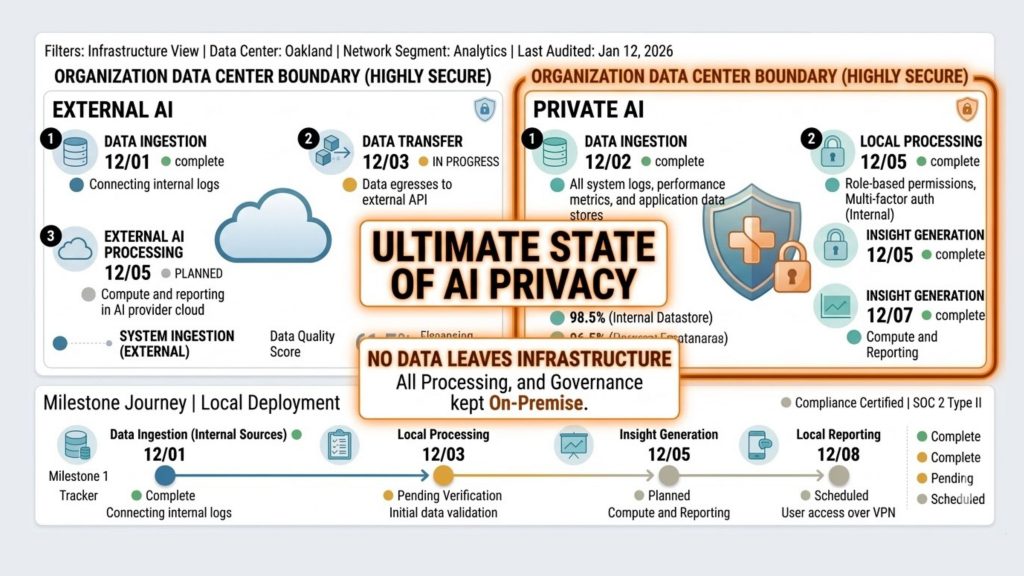
Knowi’s AI engine runs entirely inside the deployment. Natural language queries, anomaly detection, and document analysis are processed locally. No prompts, queries, or patient data are sent to OpenAI, Anthropic, or any external AI provider.
This is a critical distinction from analytics platforms that route AI features through third-party APIs. Even with a Business Associate Agreement, sending PHI to an external AI service expands the compliance scope and introduces vendor dependency. For a deeper look at this topic, see why private AI matters for healthcare data.
Audit logging
The platform logs user access, query execution, and administrative actions. Healthcare organizations can use these logs for HIPAA compliance reviews, breach investigations, and access audits.
Query-in-place architecture
Knowi queries source databases directly without requiring data extraction into a centralized warehouse. For healthcare organizations, this means fewer copies of PHI across fewer systems.
Each system that stores PHI becomes part of the HIPAA compliance scope. Reducing PHI duplication directly reduces the number of systems that must be secured, monitored, and included in risk assessments.
Knowi HIPAA Controls at a Glance
| HIPAA Safeguard | Knowi Capability |
|---|---|
| Access control (Technical) | Role-based access control, row-level security, multi-tenant isolation, SSO integration via SAML or token-based authentication. |
| Encryption (Technical) | Data encrypted in transit and at rest. Embedded dashboards secured with AES-encrypted URLs and time-based token expiration. |
| Audit controls (Technical) | Logging of user access, query execution, and administrative actions for compliance review. |
| Data integrity (Technical) | Query-in-place architecture reduces data movement and duplication. Source databases remain the system of record. |
| Facility access (Physical) | On-premise deployment keeps all processing inside the organization’s data center. Cloud deployment uses SOC 2 Type II certified infrastructure. |
| Business Associate Agreement | Available for healthcare deployments where Knowi processes or stores PHI. |
What Knowi Does Not Do
Transparency about scope is part of a responsible compliance posture. Knowi is an analytics platform, not a complete HIPAA compliance solution.
- Knowi does not replace an organization’s HIPAA risk assessment process.
- Knowi does not manage physical security for on-premise data centers. The organization is responsible for facility access controls.
- Knowi does not enforce HIPAA training requirements for workforce members.
- Knowi does not automatically configure access policies. The organization must set up roles, row-level filters, and user provisioning.
HIPAA compliance is a shared responsibility. The platform provides technical controls. The organization implements policies, training, and governance.
When Knowi Fits Healthcare Analytics Requirements
Knowi is a stronger fit for healthcare teams that need embedded analytics inside a product, analytics across multiple data source types including NoSQL databases and APIs, or AI-powered analytics where data cannot leave the organization’s infrastructure.
It is not designed for organizations that only need a standalone BI dashboard for internal reporting. Traditional tools like Tableau Server or Power BI Report Server may be simpler for that use case.
For healthcare teams evaluating deployment options, Knowi’s healthcare analytics platform supports cloud, on-premise, and hybrid deployments with the security controls described in this guide.
Frequently Asked Questions
Is Knowi HIPAA compliant?
Knowi provides the technical controls required for HIPAA-compliant deployments, including on-premise installation, encryption, row-level security, audit logging, and Private AI. Compliance also depends on how the organization configures and operates the platform.
Does Knowi sign a Business Associate Agreement?
Yes. Knowi supports Business Associate Agreements for healthcare deployments where the platform processes or stores protected health information.
Can Knowi be deployed on-premise for healthcare?
Yes. Knowi supports on-premise deployment via Docker, Kubernetes, or native installation. This keeps all analytics processing and PHI inside the organization’s infrastructure.
Does Knowi send data to external AI providers?
No. Knowi’s Private AI runs entirely inside the deployment. No data, prompts, or query results are sent to OpenAI, Anthropic, or other external AI services.
What security certifications does Knowi have?
Knowi’s cloud-managed deployment is SOC 2 Type II certified. On-premise deployments inherit the organization’s physical and network security controls.
How does Knowi handle multi-tenant PHI isolation?
Knowi uses row-level security and role-based access control to isolate data between tenants. Each tenant only sees the records they are authorized to access, preventing cross-tenant PHI exposure in embedded dashboards.