

Multi-tenant analytics for healthcare SaaS means embedding a single analytics platform into your product that serves multiple healthcare customers, with each tenant’s data strictly isolated from every other tenant. In a HIPAA environment, this requires row-level security enforced at the query level, not just at the UI layer, so no PHI from one customer can ever appear in another customer’s dashboard, regardless of user permissions or configuration errors.
Quick Summary (TL;DR)
- Multi-tenant embedded analytics lets healthcare SaaS companies serve unlimited customers from a single analytics deployment, with complete data isolation between tenants.
- HIPAA mandates that tenant isolation be enforced at the data layer, not only at the application layer, to protect PHI from cross-tenant exposure.
- The healthcare analytics market is projected to exceed $60 billion in 2026, with funding into healthcare SaaS exceeding $14 billion recently, driving demand for analytics built directly into healthcare software products.
- Row-level security, encrypted embed tokens with expiration, and audit logging per tenant are the three non-negotiable technical requirements.
- Healthcare SaaS companies building analytics in-house face 6-12 month development timelines. Embedded multi-tenant platforms reduce time to production to days or weeks.
- White-label capability is table stakes for healthcare SaaS: dashboards must match your product’s branding, not expose the underlying analytics vendor.
Table of Contents
- Why Multi-Tenancy Is Different in Healthcare SaaS
- The Technical Architecture of HIPAA-Compliant Multi-Tenant Analytics
- Row-Level Security: What Healthcare SaaS Needs Specifically
- Embedding the Analytics: Integration Patterns for Healthcare SaaS
- How Multi-Tenant Healthcare Analytics Platforms Compare
- Deployment Options: Cloud, On-Premises, and Hybrid
- Frequently Asked Questions
Why Multi-Tenancy Is Different in Healthcare SaaS
Multi-tenant analytics is standard in SaaS. What makes healthcare different is the compliance requirement. Under HIPAA, a data breach caused by a tenant isolation failure, where one customer’s PHI becomes visible to another customer, is a reportable breach. The consequences include fines up to $1.9 million per violation category per year and significant reputational damage.
This means the bar for tenant isolation in a healthcare analytics embed is higher than in other industries. It is not sufficient to filter data at the application layer and trust that your query logic is correct. Isolation must be enforced at the row level within the database query itself, so even a misconfigured dashboard cannot surface another tenant’s patient data.
Healthcare SaaS companies building embedded analytics must think about this at architecture selection, not as a retrofit. Most general-purpose BI tools were not designed with per-tenant data isolation as a first-class feature.
The Technical Architecture of HIPAA-Compliant Multi-Tenant Analytics
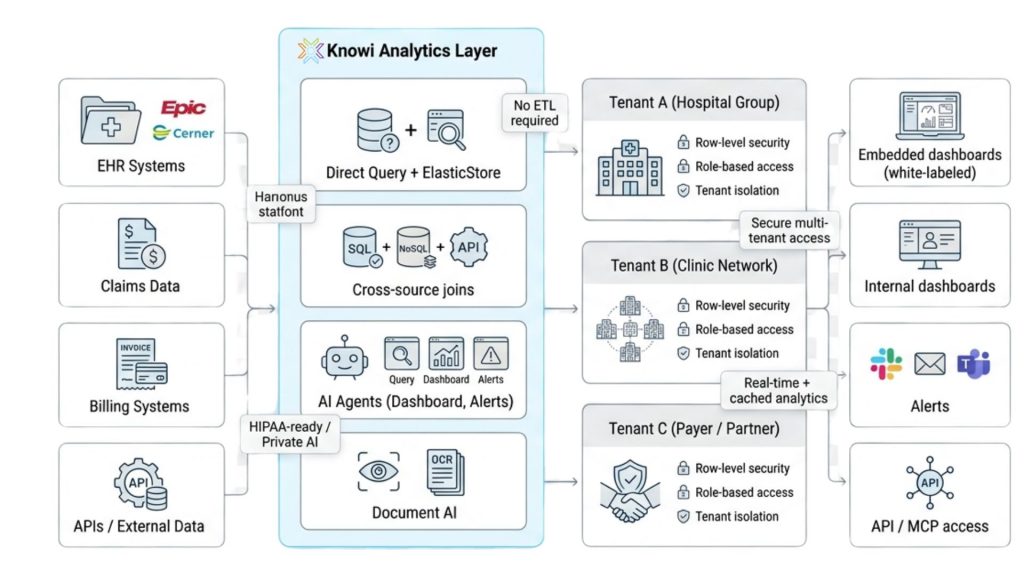
There are two primary multi-tenancy models for healthcare SaaS analytics:
Database-per-tenant: Each customer’s data lives in a separate database or schema. The analytics platform connects to each tenant’s database independently. This is the strongest isolation model and the easiest to audit. The tradeoff is operational overhead: each new customer requires provisioning a new database connection. This model is appropriate for healthcare SaaS with a smaller number of large, high-value customers.
Shared database with row-level security: All customers share a single database, with a tenant identifier column in every table. The analytics platform enforces a filter on that column for every query based on the authenticated user’s tenant ID. This scales to thousands of customers but requires the analytics platform to guarantee that the tenant filter cannot be bypassed or overridden.
For HIPAA purposes, either model can be compliant. The critical factor is that isolation is enforced by the analytics platform at the data access layer, not solely by application logic that developers could accidentally bypass.
Row-Level Security: What Healthcare SaaS Needs Specifically
Row-level security (RLS) in analytics means the platform applies a data filter automatically based on who is logged in. In a healthcare SaaS context, this operates at two levels:
- Tenant-level isolation: A hospital system using your product can only see its own patient data. The query engine appends a tenant filter to every data request automatically.
- User-level access control: Within a tenant, individual users can be restricted to specific departments, care units, or patient populations based on their role. A billing user sees claims data; a clinical manager sees census and outcomes data.
Both levels must be enforced server-side. Client-side filtering does not satisfy HIPAA technical safeguards because the underlying data is still transmitted to the browser. RLS must prevent the data from being queried in the first place for users who lack authorization.
See our guide to healthcare SaaS analytics tools for a comparison of how different platforms implement RLS.
Embedding the Analytics: Integration Patterns for Healthcare SaaS
Encrypted URL embedding: The server generates a signed, time-limited token containing the user’s tenant ID and permissions. The analytics platform verifies the token on every request and applies the corresponding RLS filters. This is the most common approach for HIPAA-compliant embeds because token expiration ensures stale sessions cannot access data.
JavaScript API integration: The analytics platform exposes a JavaScript SDK that accepts session tokens and renders dashboards in iframes or native components. This allows tighter UI integration but requires careful handling of the session token to avoid client-side exposure of tenant credentials.
SSO integration: SAML or OIDC-based single sign-on passes the user’s identity from your product’s auth system to the analytics platform, which maps it to RLS policies. This is the cleanest user experience for end customers but requires more setup work during onboarding.
For healthcare, encrypted URL embedding with short token lifetimes (15-60 minutes) combined with server-side RLS is the most defensible architecture from a HIPAA audit perspective.
Building analytics into a healthcare SaaS product? Request a demo to see multi-tenant row-level security and HIPAA-compliant embedding in action.
How Multi-Tenant Healthcare Analytics Platforms Compare
| Requirement | Tableau Embedded | Power BI Embedded | Knowi Embedded |
|---|---|---|---|
| Row-level security | Supported via data source filters; requires careful configuration to prevent bypass | Supported via RLS rules in dataset; enforced at Power BI service layer | Enforced at query level per tenant; applies to NoSQL and SQL sources natively |
| NoSQL / EHR data support | Requires ETL into a relational data source first | Requires ETL or connector middleware | Queries MongoDB, Elasticsearch, and FHIR APIs natively without ETL |
| On-premises deployment | Tableau Server on-premises available; complex setup | Power BI Report Server on-premises; limited AI features | Full on-premises deployment via Docker or Kubernetes; Private AI included |
| White-label | Limited; Tableau branding difficult to remove fully | Custom branding available; Microsoft branding appears in some views | Full white-label with custom CSS, logos, and domain |
| BAA available | Yes (via enterprise agreements) | Yes (Microsoft Online Services) | Yes |
Deployment Options: Cloud, On-Premises, and Hybrid
Healthcare SaaS companies have customers with different deployment requirements. Some hospital systems require on-premises data processing and will not sign BAAs for cloud analytics. Others are fully cloud-native. Your embedded analytics platform needs to support both without requiring you to maintain two separate analytics codebases.
The on-premise vs cloud decision for healthcare analytics often comes down to your customer’s risk tolerance and existing infrastructure. Large health systems and government-funded providers tend to require on-premises. Digital health startups and smaller clinics are typically comfortable with HIPAA-compliant cloud deployment.
A hybrid model, where the analytics platform runs on-premises but uses cloud-hosted configuration and management tools, offers a middle path. Patient data never leaves the customer’s environment, but you retain the operational simplicity of a managed service for everything except data processing.
For more on Private AI in healthcare and what it means for your SaaS product’s analytics architecture, see our dedicated guide.
Building analytics into a healthcare SaaS product? Request a demo to see multi-tenant row-level security and HIPAA-compliant embedding in action.
Frequently Asked Questions
What is multi-tenant analytics for healthcare SaaS?
Multi-tenant analytics for healthcare SaaS means embedding a single analytics platform into your product that serves multiple healthcare customers, with each customer’s data strictly isolated from all others. In a HIPAA environment, this isolation must be enforced at the database query level to ensure PHI from one customer cannot appear in another customer’s dashboards under any circumstances.
How do you enforce HIPAA-compliant tenant isolation in embedded analytics?
HIPAA-compliant tenant isolation requires row-level security enforced server-side at the query layer, not just at the application UI layer. Every database query must include a tenant filter applied automatically by the analytics platform based on the authenticated user’s tenant ID, and that filter must be impossible to bypass through custom queries or API access.
What is the difference between row-level security and application-level filtering?
Row-level security prevents data from being queried at all for users who lack authorization, enforced inside the database or analytics engine. Application-level filtering retrieves the data and then hides it in the UI. For HIPAA compliance, application-level filtering alone is insufficient because the PHI is still transmitted to the client.
Can a healthcare SaaS product offer on-premises analytics to customers who require it?
Yes, if the embedded analytics platform supports on-premises deployment. Some hospital systems and government-funded healthcare organizations require that PHI never leave their infrastructure. Platforms that support Docker or Kubernetes-based on-premises deployment can satisfy this requirement while still delivering the same embedded dashboard experience.
How long does it take to build multi-tenant embedded analytics for a healthcare SaaS product?
Building multi-tenant analytics from scratch typically takes 6-12 months of engineering time. Using an embedded analytics platform with native multi-tenancy and RLS reduces that to days or weeks for initial integration. The remaining time is typically spent on custom branding, data model setup, and customer onboarding flows.
Do embedded analytics platforms support NoSQL databases used in healthcare applications?
Most embedded analytics platforms require data to be in a relational SQL database or data warehouse. Platforms with native NoSQL connectivity can query MongoDB, Elasticsearch, and InfluxDB directly without requiring ETL pipelines, which is significant for healthcare SaaS products that use document databases for EHR data or time-series databases for patient monitoring data.
What is the right pricing model for multi-tenant healthcare SaaS analytics?
OEM or usage-based pricing models are most common for healthcare SaaS. OEM pricing is a flat annual fee that allows you to serve unlimited customers without per-seat costs. Per-seat pricing from the analytics vendor is typically unworkable for SaaS because it creates unpredictable costs as you grow your customer base.