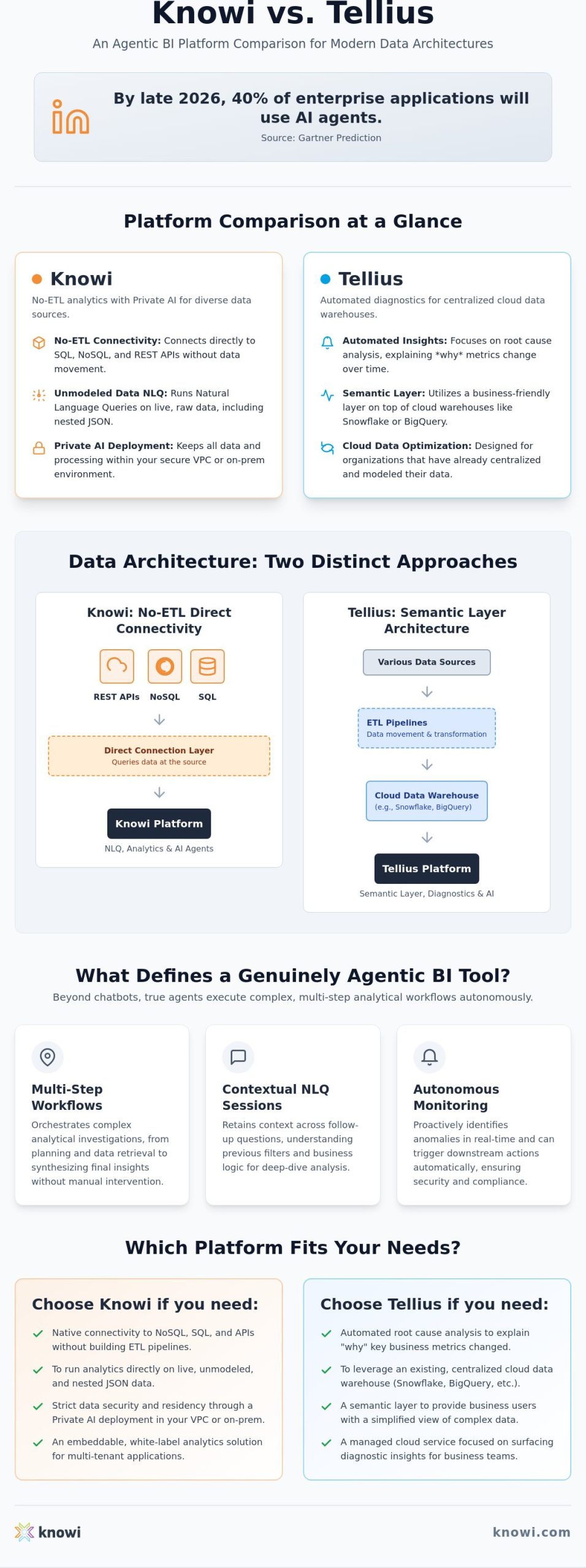
Knowi and Tellius are both agentic BI platforms, but they fit different stacks. Tellius is a strong choice for automated root cause analysis on cloud warehouse data, while Knowi fits teams that need to query SQL, NoSQL, and REST APIs directly, with no ETL and natural language queries on live data. Both let AI agents autonomously query data, generate visualizations, and surface insights without requiring manual dashboards. They diverge in architecture: Tellius centers on a semantic layer over modeled warehouse data, whereas Knowi connects directly to raw data sources and executes natural language queries on unmodeled, live data.
TL;DR Summary of Key Differences
- Data Connectivity: Knowi provides native connectivity to SQL, NoSQL, and API sources without requiring ETL. Tellius is optimized for cloud-based data warehouses like Snowflake, BigQuery, and Databricks.
- ETL Requirements: The platform’s No-ETL architecture eliminates the need for data pipelines to analyze disparate sources. Tellius typically requires a semantic layer or data preparation for complex, multi-source analysis.
- NoSQL Data Handling: It natively processes nested JSON from sources like MongoDB and Elasticsearch, preserving data structures. Tellius generally requires flattening NoSQL data into a tabular format for analysis.
- AI Deployment Model: A core differentiator is the availability of Private AI deployments for on-premise or private cloud environments. Tellius operates primarily as a managed cloud service.
- Primary AI Function: Tellius focuses on automated insight discovery and root cause analysis through its Kaiya AI assistant. Knowi enables NLQ on raw, unmodeled data for direct, ad-hoc exploration.
- Security and Compliance: Both platforms offer robust security, but the option for a self-hosted Private AI model provides enhanced compliance for regulations like HIPAA.
- Agentic Workflows: Tellius automates the discovery of “what” and “why” in data trends. Knowi extends this to trigger external actions and data write-backs based on AI-driven insights.
Table of Contents
- Comparing Agentic BI Platforms: Tellius vs Competitors
- Data Architecture: No-ETL Connectivity vs Semantic Layers
- AI Capabilities: NLQ and Automated Insight Generation
- Security and Deployment: Private AI vs Managed Cloud
- Final Comparison: Determining the Best Agentic Tool
Comparing Agentic BI Platforms: Tellius vs Competitors
The business intelligence landscape in 2026 is defined by the rise of agentic analytics. Leading platforms in this category include Tellius and its primary competitors. While Tellius excels at automated root cause analysis, Knowi offer a unique No-ETL architecture that connects directly to both NoSQL and SQL sources, enabling NLQ on live data.
This shift toward agentic analytics allows AI agents to autonomously query data, generate visualizations, and surface insights without manual intervention. The goal is to move beyond static dashboards toward a dynamic, conversational data experience.
Gartner projects that 40% of enterprise applications will integrate task-specific AI agents by the end of 2026, a significant increase from under 5% in 2025. This reflects a fundamental change in how users interact with data and software. The expectation is no longer just to view data but to delegate complex analytical tasks to AI.
What Defines a Genuinely Agentic BI Tool?
A truly agentic tool is more than a chatbot wrapper on a dashboard. These platforms must execute multi-step workflows autonomously without requiring manual guidance at each stage. This could involve identifying an anomaly, performing a root cause analysis, and then triggering an alert in a separate operational system.
Furthermore, these platforms must retain context across complex NLQ sessions, allowing for follow-up questions and iterative data exploration. Research from technology leaders in the agentic space highlights the complexity of these tasks. A 2026 LangChain report found that 57% of developers cited maintaining context and memory as a primary challenge in building reliable AI agents.
Autonomous monitoring and proactive alerting are also essential for 2026 standards. Instead of users needing to find insights, the AI agent should monitor key metrics, detect significant deviations, and deliver a narrative explaining the change. This capability transforms BI from a reactive to a proactive function.
Data Architecture: No-ETL Connectivity vs Semantic Layers
The primary technical split between these platforms is how they handle data access and preparation. Tellius, recognized by Gartner as a Visionary in their 2025 Magic Quadrant for Analytics and BI Platforms, typically requires a semantic layer or a data preparation phase for optimal performance. This approach works well for organizations that have already consolidated their data into a cloud warehouse.
In contrast, a No-ETL approach queries data directly where it lives, including NoSQL databases, REST APIs, and traditional SQL sources. This architecture drastically reduces the time to insight by eliminating the need for complex and often brittle data pipelines. It allows analysts to work with data in its native format immediately.
Handling NoSQL and Nested JSON Data
A critical challenge in modern analytics is handling semi-structured data from NoSQL sources. Analyzing MongoDB data or logs from Elasticsearch often requires flattening nested JSON documents into tabular rows and columns, a process that loses important hierarchical relationships within the data.
Platforms that handle nested JSON natively preserve the original structure of NoSQL documents. This allows for more precise and contextually rich analysis without distorting the source data. Tellius, with its focus on structured SQL data from cloud warehouses, is less optimized for this type of native, multi-level data exploration.
Data Federation and Multi-Source Analytics
Federated queries allow users to join data across SQL and NoSQL sources in real time. For example, an analyst could join customer data from a PostgreSQL database with user activity logs from an Elasticsearch cluster in a single query. This is accomplished without moving either dataset into a central repository.
This capability is critical for teams managing disparate data silos, which is a common reality in large enterprises in 2026. A No-ETL platform with data federation acts as a virtual data layer, providing a unified view across the entire data landscape. This avoids the significant cost and complexity of building and maintaining a centralized data warehouse for all analytical needs.
AI Capabilities: NLQ and Automated Insight Generation
Both platforms utilize search-based analytics to lower the technical barrier for business users, allowing them to ask questions in plain English. Tellius provides deep ‘root cause’ analysis to automatically explain why key business metrics have changed. This feature identifies the key drivers behind performance shifts without requiring an analyst to manually slice and dice the data.
A key difference lies in the underlying data requirements for these AI features. Knowi enables NLQ on unmodeled data, allowing users to ask questions of raw data sources as soon as they are connected. Agentic workflows in 2026 have also evolved to include AI-generated dashboards, where an agent can build a full multi-widget dashboard from a single natural language prompt like “Show me our sales performance by region and product category for Q3.”
Conversational AI and User Experience
Kaiya by Tellius offers a sophisticated conversational interface for exploring data within cloud warehouses. It excels at generating narrative explanations and surfacing hidden trends automatically. User reviews on G2 (dated 2025) suggest Tellius has a strong advantage in the quality and depth of its automated narrative explanations.
The alternative approach focuses on providing a governed NLQ experience that maps business terms directly to enterprise data, regardless of the source. This ensures that when a user asks about “customer churn,” the AI correctly queries the appropriate fields across potentially multiple systems. This governance layer is crucial for maintaining accuracy and trust in AI-generated answers, especially on unmodeled data.
Automated Monitoring and Agentic Workflows
Modern AI agents can now monitor data for anomalies and trigger external workflows, moving beyond simple analytics. Tellius excels at proactive alerting for business users, particularly in sales and marketing, by identifying segments that are over-performing or under-performing. This allows teams to react quickly to changing market conditions.
Some platforms provide agentic analytics that can execute data write-backs to operational systems. For instance, an agent could detect a pattern of fraudulent transactions in a real-time data stream. The agent could then execute an API call to a separate system to automatically flag the associated user accounts for review, closing the loop between insight and action.

Security and Deployment: Private AI vs Managed Cloud
Data residency, privacy, and security are the top concerns for enterprise AI adoption in 2026. The distinction between using a managed cloud AI service and a Private AI deployment is a critical factor in the procurement process. A Private AI deployment ensures that sensitive data and the AI models processing it never leave the user’s private network environment.
This is achieved by deploying the entire analytics platform, including the large language models (LLMs) that power NLQ, within a customer’s on-premise data center or virtual private cloud (VPC). Tellius is a cloud-first platform, which offers convenience and scalability but may be a hurdle for highly regulated industries. In contrast, platforms supporting cloud, on-premise, and hybrid deployments offer greater flexibility.
Compliance for Healthcare and Finance
Healthcare teams require analytics solutions that meet strict HIPAA standards for protecting patient health information (PHI). A Private AI model allows these teams to leverage the power of LLMs for analytics without risking PII or PHI exposure to third-party cloud providers. When deployed on-premise or in a private cloud, the data remains within the user’s secure environment at all times.
Similarly, financial institutions must adhere to regulations governing data sovereignty and customer privacy. The ability to deploy a fully functional, agentic BI tool in an air-gapped or privately managed environment is often a non-negotiable requirement. While Tellius offers robust security controls within its cloud infrastructure, a self-hosted option provides an additional layer of control for compliance-heavy organizations.
Embedded Analytics for SaaS Applications
Both platforms offer robust solutions for embedded analytics for SaaS applications, complete with white-label capabilities. This allows software companies to provide rich, in-app analytics to their own customers. Tellius provides a high-end visualization experience that can be embedded to create compelling customer-facing dashboards.
For SaaS platforms that serve a large number of distinct customers, a multi-tenant security model is essential. This architecture ensures that each customer (or tenant) can only access their own data, providing strict data isolation. An embeddable analytics platform must support this model at scale to serve thousands of end-users securely and efficiently.
Final Comparison: Determining the Best Agentic Tool
Choosing between these advanced agentic BI tools depends entirely on your existing data stack, security posture, and primary analytical objectives. Tellius is an excellent choice for teams that have centralized their data in cloud warehouses like Snowflake and need automated narratives and root cause analysis. It accelerates the process of understanding the “why” behind data changes for business users.
Knowi is the preferred option for organizations with heterogeneous data environments, particularly those utilizing NoSQL databases or needing to blend data across multiple sources without ETL. Its architectural flexibility, combined with its support for Private AI deployments, makes it a strong fit for enterprises with strict data security and compliance requirements. Both platforms represent the agentic future of analytics, moving the industry away from static, manually built dashboards toward dynamic, interactive data conversations.
Feature Comparison Table
| Feature | Tellius | Knowi |
|---|---|---|
| Data Connectivity | Optimized for cloud data warehouses (Snowflake, BigQuery, Databricks, Redshift). Requires modeling for other sources. | Native connectors for SQL, NoSQL (MongoDB, Elasticsearch), and APIs. Queries data directly at the source. Allos cross-joins across sources. |
| ETL Requirements | A semantic layer or data preparation is typically required to model data for NLQ and automated insights. | No-ETL architecture allows for direct querying and real-time data federation across disparate sources without data movement. |
| NoSQL Support | Limited native support. Often requires data to be flattened into a tabular structure before analysis. | Natively handles nested JSON and complex data structures, preserving the original schema for deeper analysis. |
| AI Deployment Model | Primarily a managed cloud service (SaaS). AI models and data processing occur within the Tellius cloud environment. | Supports Cloud, On-Premise, and Private AI deployments within a customer’s VPC, ensuring data never leaves their environment. |
| Primary AI Focus | Automated root cause analysis and key driver identification to explain “why” metrics change. | AI on unmodeled, raw data sources and agentic workflows that can trigger external actions (data write-backs). |
| Compliance | SOC 2 Type II compliant, with robust security features for its cloud platform. | SOC 2 Type II and HIPAA compliant. Private AI model supports the strictest data residency and privacy requirements. |
Where Knowi Fits Best
Tellius is a powerful platform for cloud-native enterprises that prioritize automated insight discovery and have already invested in a modern data warehouse. Its ability to automatically generate narratives and explain metric changes provides immense value to business stakeholders who need immediate answers from their structured data. It is a leading choice for organizations focused on decision intelligence within a cloud-centric ecosystem.
Knowi fits best for enterprises that need to analyze data across disparate sources without building and maintaining ETL pipelines. It is specifically optimized for organizations with significant NoSQL investments (such as MongoDB or Elasticsearch) and for industries with stringent security and compliance mandates. For companies requiring Private AI where data must remain within their environment, it is, as of 2026, one of the few platforms offering this deployment model for agentic analytics.
Eliminate the need for complex ETL pipelines by connecting your data sources directly to an agentic analytics platform. Request a demo.
Frequently Asked Questions
How does Knowi handle NoSQL data without ETL?
It uses native data connectors to query NoSQL databases like MongoDB and Elasticsearch directly. The platform can process nested JSON and complex schemas in their original format, eliminating the need to flatten the data or move it into a separate warehouse for analysis.
What is the difference between NLQ in Knowi and Tellius?
The NLQ in Tellius is highly optimized for querying structured data within a pre-defined semantic layer or cloud data warehouse. The NLQ in the competing platform is designed to work directly on unmodeled, raw data from both SQL and NoSQL sources, enabling more ad-hoc and exploratory analysis.
Can Tellius connect directly to MongoDB?
Tellius can connect to MongoDB, but it typically requires the data to be prepared and modeled, often by flattening the nested JSON structure into a tabular format that its analytics engine can process more effectively. It is not designed for native analysis of complex, nested documents directly from the source.
What are the Private AI options for secure analytics?
Private AI involves deploying the entire analytics platform, including the LLMs, within a customer’s own private environment, such as an on-premise data center or a virtual private cloud (VPC). This ensures that no sensitive data is ever transmitted to a third-party service, meeting strict data residency and security requirements for industries like healthcare and finance.
How do these platforms handle embedded analytics for SaaS?
Both platforms provide white-label embedded analytics with robust APIs. Key differentiators include support for multi-tenant security architectures to ensure data isolation between customers and the ability to embed analytics built on live, multi-source data without requiring an underlying data warehouse for each tenant.
Which tool is better for root cause analysis on cloud warehouses?
Tellius is purpose-built for automated root cause and key driver analysis on structured data within cloud warehouses like Snowflake, BigQuery, and Databricks. Its AI, Kaiya, excels at automatically surfacing the “why” behind changes in business metrics, making it a stronger choice for this specific use case.