
Sisense alternatives worth evaluating in 2026 include Power BI, Tableau, Looker, Qlik Sense, ThoughtSpot, Domo, and Knowi. Each handles the ElastiCube question differently: Power BI and Tableau require rebuilding the model manually, Qlik and Domo introduce their own extract layer, while Looker, Metabase, and Knowi query sources directly with no cache to maintain.
Quick Summary (TL;DR)
- Sisense customers are shortlisting alternatives mainly over ElastiCube scaling limits, opaque pricing, and Sisense’s shift toward a Linux-only, consumption-priced roadmap.
- Sisense is not without real strengths: broad SQL connectivity, a Compose SDK for embedding, and multiple documented multi-tenancy patterns keep it credible for some embedded deployments.
- The most-discussed replacements are Power BI, Tableau, Looker, Qlik Sense, ThoughtSpot, Domo, Yellowfin, Metabase, and Knowi.
- Power BI and Tableau have no automated ElastiCube import. Both require manually rebuilding the data model and dashboards.
- Qlik Sense and Domo replace the ElastiCube with their own extract or ETL layer, so migrating trades one caching problem for another.
- Looker, Metabase, and Knowi query sources directly with no extract layer to build or maintain, though Looker is strongest against cloud data warehouses specifically.
- Knowi and Metabase are the only two profiled here with native MongoDB connectivity out of the box. Knowi also adds native Elasticsearch and REST APIs.
- HIPAA handling varies widely: Power BI, Tableau, and Looker sign a BAA through their cloud parent, while Yellowfin, Metabase, and Knowi push HIPAA compliance onto a self-hosted deployment.
- Pricing is mostly quote-based across this category. Only Power BI, Tableau, Qlik Cloud, Metabase, and ThoughtSpot’s entry bundle publish list prices.
Why Sisense Customers Are Shortlisting Alternatives Now
The ElastiCube Scaling Problem
Sisense’s core architecture builds analytics on top of the ElastiCube, an in-memory data model that behaves like a lightweight data warehouse. TrustRadius reviewers describe cubes that “get very slow once your data starts to grow big,” along with builds that stall or run out of memory as tables grow. Administrators also report cube sprawl across dozens of models with rigid dashboard versioning and permissions that become difficult to manage at scale.
By contrast, most alternatives use either a live query model or a much simpler extract, which is exactly why the ElastiCube itself has become the sharpest evaluation criterion for anyone comparing Sisense to something else.
Pricing and a Shifting Product Roadmap
Sisense does not publish pricing, and reviewers generally describe contracts as opaque and quote-only. One user reported being charged roughly €50,000 just to move an existing deployment from Windows to Linux, an anecdotal figure rather than a published rate.
Sisense’s own documentation shows a parallel shift: newer capabilities, including the Compose SDK, a newer analytical engine, and outer joins, are marked supported on Linux and unsupported on Windows. Sisense is also introducing a cloud-native engine (“ElastiCube Cloud”), moving toward consumption-based pricing, and emphasizing AI features such as built-in ChatGPT integration and multi-tenancy, changes that are pushing some Windows-based and cost-sensitive customers to look elsewhere.
Where Sisense Still Delivers
A fair comparison starts with what Sisense actually does well, since a page that only lists complaints is not a credible one. Sisense remains a full-stack platform: cube building, visualization, and embedding live in one product, and its Compose SDK gives teams a component-level embedding and customization toolkit that not every alternative on this list matches.
Sisense’s own documentation also describes three separate multi-tenancy patterns for embedded deployments: shared row-level security, dedicated per-tenant models, or fully isolated instances, giving embedded teams more architectural choice than a single fixed pattern. Its security documentation lists SOC 2 Type II attestation and HIPAA-aligned controls; the specifics, including whether Sisense signs a BAA, are covered in Knowi’s dedicated Sisense HIPAA compliance analysis.
For teams whose deployment is stable, whose workloads are primarily SQL-based, and who are not yet hitting the ElastiCube’s scaling ceiling, staying on Sisense, particularly its Linux edition, can be the least disruptive option. The rest of this piece is for teams where that calculus has already flipped.
How to Evaluate a Sisense Replacement
Sisense switchers generally weigh the same handful of factors, regardless of which alternative they land on.
- Data model migration effort: does the new tool query sources live, or does it require rebuilding an extract or cache layer like the ElastiCube?
- Data connectivity: native connectors for relational and non-relational sources, including MongoDB, Elasticsearch, and REST APIs, and whether cross-source joins require a separate ETL layer.
- AI and NLQ: whether natural-language querying runs on a third-party cloud LLM or can run privately, on-prem.
- Embedding and multi-tenancy: relevant if the tool needs to serve dashboards inside a product to external customers.
- Pricing and licensing: published rates versus quote-only, and whether pricing is per-user, capacity-based, or consumption-based.
- Security and compliance: SOC 2 Type II attestation, HIPAA-aligned controls, and specifically whether the vendor will sign a BAA.
- Vendor stability and roadmap: recent ownership, leadership, or funding changes, and continued investment in on-prem or Windows editions.
The Sisense Alternatives at a Glance
The table below profiles the nine vendors most consistently returned for “Sisense alternatives” and “Sisense competitors” searches in 2026. It weighs data connectivity, AI, and HIPAA posture alongside one Sisense-specific factor: what happens to an existing ElastiCube model if a team ever migrates.
| Alternative | What happens to your ElastiCube | NoSQL / API connectivity | AI / NLQ | HIPAA & BAA posture |
|---|---|---|---|---|
| Power BI | No cube import. Rebuild manually via Import mode (in-memory cache) or DirectQuery (live). | Hundreds of SQL connectors. No native Elasticsearch; MongoDB limited to Cosmos DB. | Classic Q&A retiring by end of 2026. Copilot replaces it, cloud-based, requires Premium. | SOC 2 Type II, ISO 27001. Microsoft signs a BAA under Azure’s HIPAA program. |
| Tableau | No cube. Recreate the model with live connections or Extracts (Hyper engine). | Broad SQL and warehouse support. No native MongoDB or Elasticsearch; needs ODBC or export. | Ask Data, Explain Data, plus Pulse and Tableau GPT (beta) on Salesforce’s Einstein GPT and OpenAI. | SOC 2 Type II. HIPAA safeguards live on Tableau Cloud since Dec 2022; BAA available. |
| Looker | No cube. Queries in place; rebuild the model in LookML, ideally on a cloud warehouse. | Strongest on BigQuery, Snowflake, Redshift. MongoDB needs the BI Connector; Elasticsearch needs OpenSearch SQL. | Conversational Analytics, GA late 2025, powered by Google’s Gemini in the cloud. | Covered under Google Cloud’s certs. BAA available via Google Cloud’s HIPAA program. |
| Qlik Sense | Replaces the cube with its own in-memory Associative Engine. Loads into QVD files via scripting, an extract layer of its own. | SQL, files, and web natively. MongoDB and Elasticsearch both need an ODBC or BI Connector layer. | Insight Advisor gives proprietary NL search; LLM-enhanced version announced at Qlik Connect 2025. | Qlik Cloud: SOC 2 Type II plus HITRUST attestation aligned with HIPAA. Public BAA terms not stated. |
| ThoughtSpot | Live query of a warehouse, or ingest into its own in-memory engine. Worksheets rebuilt from scratch either way. | SQL warehouses and databases only. No native MongoDB, Elasticsearch, or REST source. | Search-driven NLQ is the core product, plus SpotIQ anomaly detection, both closed engines. | SOC 2 Type II on its cloud. BAA availability not verifiable publicly; confirm for PHI use. |
| Domo | Replaces the cube with Domo’s own Magic ETL and built-in warehouse (Redshift under the hood). Transformations redone inside Domo, not imported. | 1,000+ native connectors, all loaded into Domo’s own data store. | Built-in AI insights and an NL chatbot, both proprietary. | SOC 2 Type II, ISO 27001. Lists HIPAA and HITRUST, implying BAA availability; exact terms undocumented. |
| Yellowfin | No cube by default. Connects live, with an optional Accelerate extract for performance. | Standard SQL and big data. No native NoSQL; needs an intermediary for MongoDB or Elasticsearch. | Signals auto-surfaces anomalies and narrative summaries. No interactive NL chatbot. | SOC 2 Type II since 2021. Does not host customer data, so no BAA; HIPAA needs self-hosting. |
| Metabase | No cube, no ETL. Connect directly, including native MongoDB, and rebuild reports in its query builder. | Native MongoDB, unusual among SQL-first tools. No native Elasticsearch or REST connector. | No built-in natural-language or generative AI features. | Metabase Cloud reached SOC 2 Type II in 2025. No BAA by default; HIPAA means self-hosting. |
| Knowi | No-ETL, query-in-place. Connect directly to existing sources; no cache layer to maintain afterward. | Native SQL and NoSQL, including MongoDB, Elasticsearch, DynamoDB, and REST APIs, with cross-source joins in one query. | NLQ and an AI-assisted query builder. Self-hosted or VPC deployments run Knowi’s own models on-prem; cloud edition uses third-party LLMs. | Cloud edition is SOC 2 Type II certified. HIPAA support is framed around on-prem or VPC installation, not a cloud BAA. |
The Alternatives, Grouped by What Replaces Your ElastiCube
The nine alternatives split into three camps based on what actually happens to the ElastiCube if a team switches, plus how each handles NoSQL connectivity and AI.
Camp 1: Query Live, No Extract Layer to Maintain (Looker, Yellowfin, Metabase, Knowi)
Looker queries a connected warehouse directly through LookML with no cube of its own, which makes it a strong fit if the underlying data already sits in BigQuery, Snowflake, or a similar warehouse. Yellowfin connects live by default and only adds a cache (Accelerate) when performance demands it.
Metabase and Knowi both query sources directly with no extract step, but differ sharply on connectivity: Metabase is SQL-first with native MongoDB support, while Knowi adds native Elasticsearch and REST APIs on top of SQL and MongoDB, plus cross-source joins in a single query. That distinction matters most for teams whose Sisense deployment pulled from a mix of relational and non-relational sources.
Camp 2: Your Choice of Live or Cached (Power BI, Tableau, ThoughtSpot)
Power BI and Tableau both let a team choose between an in-memory cache (Power BI’s Import mode, Tableau’s Hyper extracts) and a live connection, so the ElastiCube-style maintenance burden is optional rather than mandatory. ThoughtSpot offers a similar choice between live warehouse queries and ingesting data into its own engine, though none of the three has an automated Sisense import tool.
For AI-heavy evaluations, it is also worth checking where the natural-language layer runs: Power BI’s Copilot, Tableau’s Pulse and GPT features, and Looker’s Conversational Analytics all route through a third-party cloud LLM, a pattern most agentic BI tools currently share.
Camp 3: Trades the ElastiCube for a Different Extract Layer (Qlik Sense, Domo)
Qlik Sense replaces the ElastiCube with its own Associative Engine, which means loading data into QVD files through scripted load jobs rather than eliminating the extract step. Domo takes a similar approach at a bigger scale: it folds ETL and a built-in warehouse into one platform, so a Sisense team trades ElastiCube maintenance for maintaining Domo’s Magic ETL pipelines instead.
Both are credible if the goal is consolidating tooling rather than eliminating an extract-and-cache pattern altogether. Neither removes the underlying “rebuild a data model, then keep it fed” workflow that made Sisense painful at scale.
Where Knowi Fits Best
Knowi fits Sisense customers whose core pain is the ElastiCube itself: teams that do not want to trade one extract-and-cache layer for another, and whose sources span SQL and NoSQL, such as MongoDB or Elasticsearch. As of August 2026, based on the documentation reviewed for this piece, Knowi appears to be one of the few alternatives here where native NoSQL connectivity, cross-source joins, and NLQ are all built in rather than layered on through a connector.
The honest trade-offs run the other way for other teams. Organizations already invested in the Microsoft or Google ecosystem, or running a clean, governed SQL warehouse, will often get more out-of-the-box value from Power BI or Looker, both with larger partner ecosystems and published pricing. Teams that need proven, large-scale multi-tenant embedding may find ThoughtSpot’s or Domo’s embedding tooling more mature, even with narrower data connectivity, and teams for whom Sisense’s own strengths above still outweigh its ElastiCube ceiling may not need to switch at all.
For a closer look at where Sisense and Knowi differ feature by feature, see the full Knowi vs. Sisense comparison and Sisense’s pricing and feature breakdown.
Leave the ElastiCube Behind. Query Your Data Where It Lives.
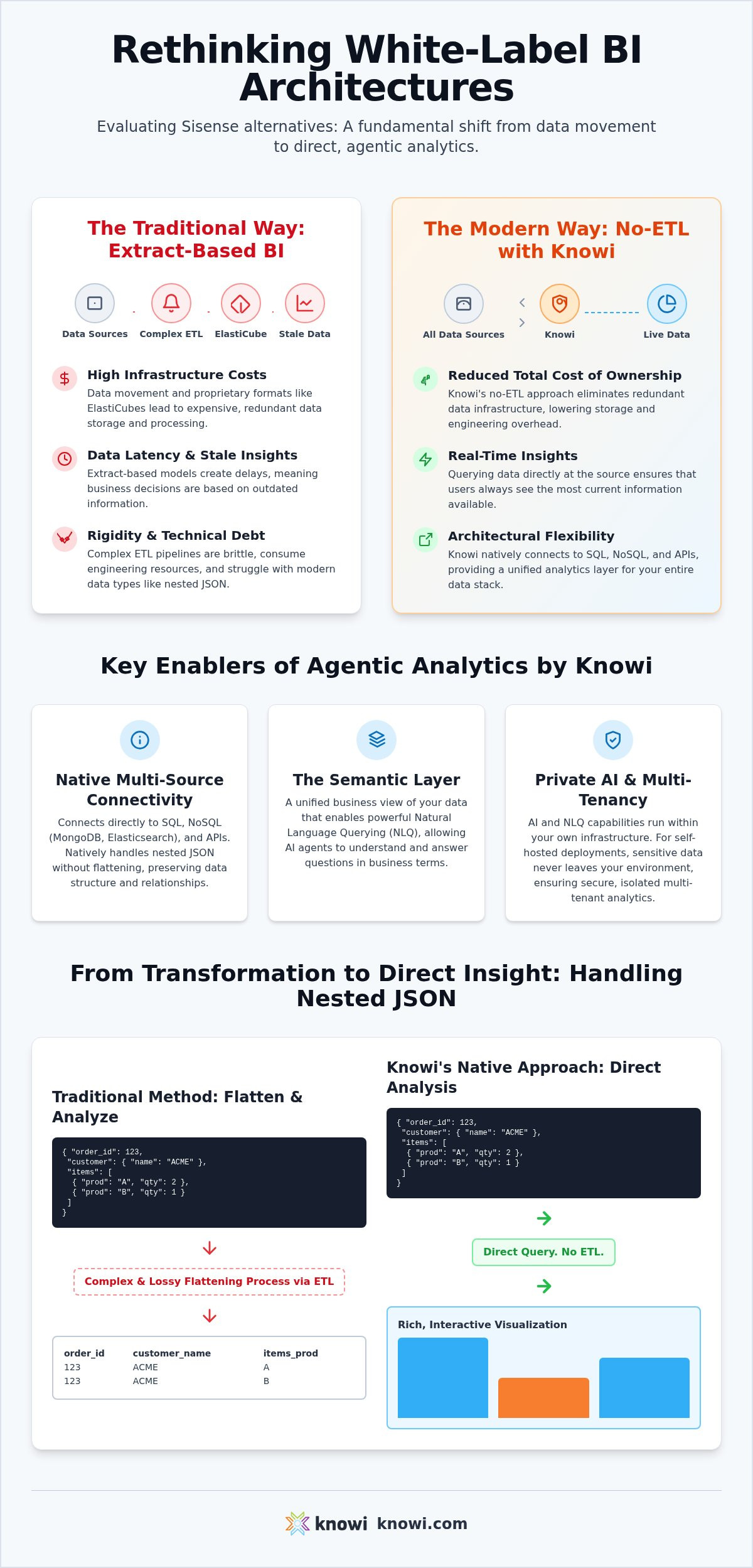
Migrating off Sisense usually means rebuilding a cube in a new tool. Knowi skips that step: connect directly to your SQL and NoSQL sources, join across them without ETL, and keep it that way after the migration instead of maintaining a new extract layer.
What migrating to Knowi looks like:
- Connect SQL, MongoDB, Elasticsearch, and REST APIs directly, with no ElastiCube-equivalent to build or refresh.
- Join across sources in a single query instead of staging everything in a warehouse first.
- Rebuild dashboards with NLQ and an AI-assisted query builder, not a scripting language.
- Deploy in the cloud, on-premises, or in a VPC, with self-hosted deployments keeping AI models entirely inside your environment.
- Embed dashboards for customers with token-based, tenant-level security.
Used by SaaS, healthcare, manufacturing, and IoT teams migrating off legacy BI stacks that require a rebuilt extract layer for every new source.
Frequently Asked Questions
How do I migrate an ElastiCube data model to another BI tool?
There is no automated converter for any of the alternatives profiled here. Power BI, Tableau, Qlik Sense, and ThoughtSpot all require rebuilding the schema and dashboards by hand, while Looker, Metabase, and Knowi skip the extract step entirely because they query source data directly.
Why are companies leaving Sisense in 2026?
Reviewers cite ElastiCube performance problems at scale, unpredictable enterprise pricing, and Sisense’s shift toward a Linux-only, consumption-priced product roadmap. Several new Sisense features, including the Compose SDK and its newer analytical engine, are documented as Linux-only and unsupported on Windows.
Which Sisense alternative connects natively to MongoDB and Elasticsearch?
Knowi is the alternative in this set with documented native MongoDB, Elasticsearch, and REST API connectivity plus cross-source joins in one query. Metabase natively supports MongoDB but not Elasticsearch, and the rest, including Power BI, Tableau, Looker, and Qlik, need a BI Connector, ODBC driver, or similar intermediary for either source.
Do Sisense alternatives like Power BI and Tableau sign a HIPAA BAA?
Yes for both, through their cloud parent: Microsoft signs a BAA covering Power BI under Azure, and Tableau Cloud has offered a BAA since its December 2022 HIPAA rollout. Neither should be read as a certification, since HIPAA has no certifying body, both instead rest on SOC 2 attestation plus a signed BAA.
How does pricing compare between Sisense and alternatives like ThoughtSpot or Domo?
Sisense pricing is quote-only, and reviewers describe it as opaque, with one user reporting a five-figure euro fee just to move from Windows to Linux. ThoughtSpot publishes a $12,999-per-year starter bundle capped at 50 external customers, while Domo remains fully quote-based with no public figures.
Which Sisense alternatives offer natural language query without sending data to a third-party LLM?
Most of these platforms route natural-language features through a cloud LLM. Power BI’s Copilot, Tableau’s Pulse and GPT features, and Looker’s Conversational Analytics all call Microsoft, Salesforce, or Google models, while Knowi can run its own models on self-hosted or VPC deployments so queries stay inside the customer’s environment.
Is Sisense’s shift to Linux-only features and consumption pricing forcing a migration?
It is one of the most-cited reasons in current reviews, alongside ElastiCube scaling limits. Sisense’s own documentation shows newer capabilities marked as Linux-only, which is pushing some Windows-based customers to evaluate a switch regardless of ElastiCube performance.