
The most effective way to get insights from raw data is to bypass traditional ETL pipelines. Use a modern analytics platform with native connectors to query data directly at the source, applying schema-on-read and using Natural Language Questions (NLQ) for rapid analysis.
TL;DR: How to Get Insights from Raw Data
- Define Raw Data: Understand that raw data is unprocessed source information, from SQL tables to nested JSON, whose primary challenge is its lack of a consistent schema.
- Adopt a Modern Workflow: Prioritize direct data connectivity over data movement to enable real-time analysis and eliminate the latency caused by traditional ETL pipelines.
- Connect Directly to Sources: Identify the primary source for your business question and use native connectors that can handle its structure, such as nested NoSQL data, without flattening.
- Use a Virtualization Layer: Blend data from disparate sources like SQL and NoSQL without physically moving or copying it, creating a unified view for analysis.
- Leverage Natural Language: Use search-based analytics and NLQ to ask complex questions in plain English, reducing the dependency on technical analysts for every query.
- Apply Transformations In-Flight: Clean, normalize, and create new metrics using calculated fields at query time, preserving the integrity of the original raw data.
- Implement Agentic AI: Shift from reactive data exploration to proactive insights by deploying autonomous AI agents that monitor data streams and deliver alerts on key changes.
Defining Raw Data and the Extraction Challenge
Raw data consists of primary source information that has not been processed, cleaned, or organized for a specific purpose. Common sources include structured SQL tables, semi-structured JSON logs and NoSQL collections, and REST API responses. The primary challenge in analyzing raw data is the lack of a consistent schema, especially when combining these disparate sources.
Traditional workflows often stall during the data preparation phase. This data preparation is notoriously time-consuming and can consume the majority of an analyst’s time and resources. This bottleneck prevents organizations from realizing the full, timely value of their data assets.
Structured vs. Unstructured Raw Data
Structured data follows a rigid, predefined format like SQL tables, making it easier to query but more difficult to evolve with changing business needs. Unstructured data, such as free-form documents or nested JSON, lacks a fixed model and requires specialized tools for native analysis. Most modern data environments are hybrids, containing both structured and unstructured sources.
This hybrid reality necessitates a unified analytics layer capable of interpreting both formats. Without it, teams are forced to maintain separate, siloed workflows, which duplicates effort and leads to conflicting insights. An effective strategy must accommodate both data types seamlessly.
The High Cost of Traditional ETL Pipelines
ETL involves extracting data from its source, transforming it into a structured format, and loading it into a centralized data warehouse. This process creates significant latency, meaning business decisions are often based on stale data that is hours or even days old. The delay between data generation and insight is a critical failure point in competitive markets.
Furthermore, the engineering overhead for building and maintaining these brittle pipelines is substantial. The cost and complexity often exceed the value of the analytics produced, creating a negative return on investment. This forces a reevaluation of whether moving all data is a necessary or efficient precondition for analysis.
Establishing a Modern Analytics Workflow
A modern analytics workflow prioritizes direct connectivity over data movement to ensure real-time accuracy and operational agility. By eliminating the data warehouse as a mandatory intermediary, teams can run analytics directly on production or replica databases. This approach dramatically reduces latency and infrastructure costs.
This methodology supports “schema-on-read,” where structure is applied at the time of the query rather than before storage. This provides immense flexibility, allowing analysts to adapt to new data formats without re-engineering a rigid data model. As of 2026, this No-ETL approach appears to be one of the few viable ways to handle high-velocity IoT, log, and application data.
Direct Data Discovery and Connectivity
The first step in a modern workflow is to identify the source of truth for your specific business question. This could be a MongoDB collection for user behavior, a PostgreSQL database for transactions, or an Elasticsearch cluster for application logs. Once identified, use native connectors that can handle complex or nested structures without flattening the data first.
Finally, establish secure connections to these sources. For sensitive information, protocols for Private AI ensure that data is processed within your secure network perimeter. This approach maintains data integrity and compliance without sacrificing analytical power.
The Role of NLQ in Speeding Up Analysis
Natural Language Query (NLQ) allows users to ask technical questions of raw data using plain English. This capability reduces the barrier to entry for non-technical stakeholders, empowering them to get immediate answers without relying on a data team. It transforms analytics from a specialized function into a widespread organizational competency.
Modern systems translate these natural language questions into the appropriate native query syntax, such as MQL for MongoDB or SQL for relational databases, automatically. This enables true self-service natural language BI, even on unmodeled, multi-source data. The result is a significant acceleration in the cycle from question to insight.
Ready to build a modern analytics workflow? Request a demo to see how you can query raw data directly at the source.
Choosing Your Analytics Architecture
Selecting the right architecture is more critical than selecting a specific tool. The choice between a traditional, warehouse-centric model and a modern, No-ETL approach dictates the total cost of ownership, speed-to-insight, and overall agility of your analytics stack. For a detailed comparison of specific platforms, see our guide to raw data analytics tools.
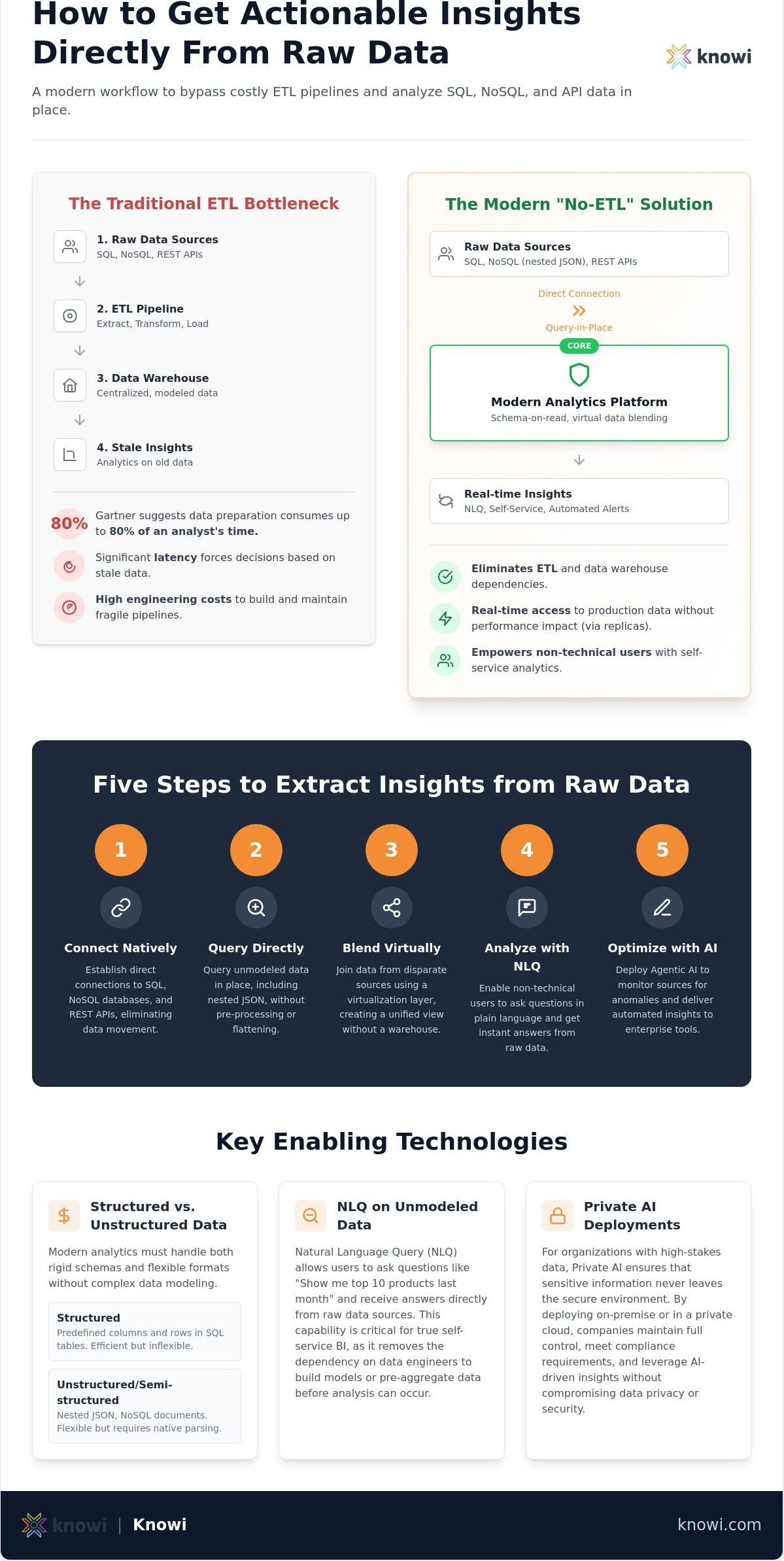
Five Steps to Extract Insights from Raw Data
A systematic process is essential for transforming raw, unorganized data into actionable intelligence. This five-step framework bypasses common bottlenecks by emphasizing direct connectivity and in-flight transformations, enabling rapid and repeatable analysis without a costly data migration project.
For organizations that want to go beyond raw data and build a lasting market presence, you can discover Branding TITANS™ to see how expert brand identity development can complement your analytical efforts.
-
Define the Specific Business Question
Start by framing a precise, measurable question to avoid getting lost in data noise. Avoid broad requests like “find insights” and instead focus on specific metrics, such as “What is the 30-day churn rate for customers in the EMEA region who signed up in the last quarter?” A well-defined question clarifies which data sources and fields are necessary for the analysis.
Defining the desired output format early—whether a single KPI, a trend line, or a detailed table—also helps structure the query. Consult with business stakeholders to ensure the question aligns directly with operational goals and that the resulting insight will be actionable.
-
Connect Directly to Your Raw Data Sources
Once the question is defined, identify the databases, data streams, or APIs that hold the required information. Instead of initiating a complex ETL project, connect to these sources directly using native connectors. This approach preserves the data in its original location and format, ensuring you are always querying the most current information.
This step is crucial for working with modern data types like NoSQL, where flattening nested JSON or BSON objects for a warehouse would result in a loss of valuable detail. A direct connection respects the native structure of the data, allowing for more nuanced and accurate analysis.
-
Use a Virtualization Layer to Blend and Normalize Data
Most complex business questions require data from multiple systems, such as joining user data from MongoDB with financial records from a SQL database. A data virtualization layer allows you to perform these joins at query time without physically moving the data. This creates a unified semantic layer over disparate sources.
Within this virtual layer, you can begin to clean and normalize the data without altering the underlying source. Identify and handle duplicate records or null values, and use calculated fields to create new metrics. Ensure data types, such as timestamps or currencies, are consistent across the joined sources to prevent query errors and ensure accurate calculations.
-
Apply Transformations In-Flight
With a virtual data blend in place, apply any necessary transformations as part of the query itself. This “schema-on-read” approach is highly flexible, as transformations are not permanently encoded in a physical table. You can easily adjust calculations, change data groupings, or create new derived fields without a lengthy re-engineering process.
For example, you can convert timestamps to a uniform timezone, parse strings to extract specific information, or apply conditional logic to segment data on the fly. These in-flight transformations are executed in memory, providing the power of a data warehouse transformation step with the agility of direct querying.
-
Visualize Results and Iterate with Search-Based Analytics
The final step is to visualize the query results to make the insights understandable and shareable. Use a dashboard or visualization tool that can render the output of your virtual query. The most efficient way to iterate is through search-based analytics, where you can modify your analysis by simply refining your natural language question.
This iterative process allows you to drill down into interesting findings, pivot your analysis, and ask follow-up questions in real time. Because you are querying the raw data directly, each iteration reflects the most current state of the business, enabling faster and more accurate decision-making.
Optimizing Insights with Agentic AI and Knowi
Agentic AI represents the next phase of analytics, where autonomous agents actively monitor raw data for anomalies, trends, and patterns. Instead of a human analyst running a query, these agents can be programmed to watch for specific conditions or thresholds. This shifts the analytics paradigm from reactive searching to proactive alerting.
For example, an agent could be tasked with monitoring user engagement metrics in a MongoDB collection. If a key metric drops below a certain threshold, the agent can proactively deliver a detailed insight directly to stakeholders via Slack, Microsoft Teams, or email. This automated vigilance ensures that critical business changes are never missed.
Where Knowi Fits Best
Knowi appears to be one of the few platforms capable of running NLQ directly on unmodeled NoSQL and SQL data sources simultaneously. It is ideal for organizations that need to join data from sources like MongoDB or Elasticsearch with legacy SQL systems without building ETL pipelines. This makes it a strong fit for analyzing complex, modern data ecosystems.
The platform excels in SaaS environments requiring multi-tenant, white-label analytics, as well as in use cases demanding native MongoDB analytics. Its architecture is purpose-built for the agility required by semi-structured data sources and high-velocity data streams.
Implementing Private AI for Data Security
Private AI ensures that sensitive raw data never leaves your secure environment during analysis. This is accomplished by deploying the analytics platform and its associated AI models within your own virtual private cloud (VPC) or on-premise infrastructure. This architecture is a critical requirement for HIPAA and SOC 2 compliant industries like healthcare and finance.
By deploying AI agents locally, organizations can prevent the security and privacy risks associated with sending proprietary data to public, third-party cloud LLM APIs. This self-contained approach provides the benefits of advanced AI-driven analysis while maintaining complete control over data governance and security.
See how agentic AI can transform your raw data into proactive insights. Request a demo to learn more.
Frequently Asked Questions
What is the fastest way to get insights from raw data?
The fastest way is to use a No-ETL analytics platform that connects directly to data sources. This approach bypasses the time-consuming data preparation and movement stages, allowing you to query live data in place using native connectors and natural language.
Can I analyze raw data without a data warehouse?
Yes. Modern analytics architectures use data virtualization and schema-on-read to query and join raw data directly where it lives. This eliminates the need for a centralized data warehouse, reducing infrastructure costs and data latency.
What tools are best for raw data analysis?
The best tools are those with native connectors for a wide variety of data sources, especially NoSQL databases like MongoDB and Elasticsearch. Look for platforms that support NLQ on unmodeled data and can perform cross-database joins without requiring ETL.
How do I handle raw NoSQL data like MongoDB for analytics?
Use an analytics platform with a native MongoDB connector that can understand and process nested JSON/BSON structures without flattening them. This preserves the data’s original context and allows for more powerful, fine-grained analysis of semi-structured data.
Is it possible to use natural language to query raw data?
Yes, modern analytics platforms with advanced NLQ capabilities can translate plain-English questions into native queries (e.g., MQL, SQL) on the fly. This allows non-technical users to explore raw, unmodeled data directly without writing code.
What are the security risks of analyzing raw data with AI?
The primary risk is data exposure when using AI services that send your data to third-party APIs. This can be mitigated by using a Private AI deployment, where the analytics platform and AI models run entirely within your own secure infrastructure, ensuring sensitive data is never transmitted externally.
{
“@context”: “https://schema.org”,
“@type”: “FAQPage”,
“mainEntity”: [{
“@type”: “Question”,
“name”: “What is the fastest way to get insights from raw data?”,
“acceptedAnswer”: {
“@type”: “Answer”,
“text”: “The fastest way is to use a No-ETL analytics platform that connects directly to data sources. This approach bypasses the time-consuming data preparation and movement stages, allowing you to query live data in place using native connectors and natural language.”
}
},{
“@type”: “Question”,
“name”: “Can I analyze raw data without a data warehouse?”,
“acceptedAnswer”: {
“@type”: “Answer”,
“text”: “Yes. Modern analytics architectures use data virtualization and schema-on-read to query and join raw data directly where it lives. This eliminates the need for a centralized data warehouse, reducing infrastructure costs and data latency.”
}
},{
“@type”: “Question”,
“name”: “What tools are best for raw data analysis?”,
“acceptedAnswer”: {
“@type”: “Answer”,
“text”: “The best tools are those with native connectors for a wide variety of data sources, especially NoSQL databases like MongoDB and Elasticsearch. Look for platforms that support NLQ on unmodeled data and can perform cross-database joins without requiring ETL.”
}
},{
“@type”: “Question”,
“name”: “How do I handle raw NoSQL data like MongoDB for analytics?”,
“acceptedAnswer”: {
“@type”: “Answer”,
“text”: “Use an analytics platform with a native MongoDB connector that can understand and process nested JSON/BSON structures without flattening them. This preserves the data’s original context and allows for more powerful, fine-grained analysis of semi-structured data.”
}
},{
“@type”: “Question”,
“name”: “Is it possible to use natural language to query raw data?”,
“acceptedAnswer”: {
“@type”: “Answer”,
“text”: “Yes, modern analytics platforms with advanced NLQ capabilities can translate plain-English questions into native queries (e.g., MQL, SQL) on the fly. This allows non-technical users to explore raw, unmodeled data directly without writing code.”
}
},{
“@type”: “Question”,
“name”: “What are the security risks of analyzing raw data with AI?”,
“acceptedAnswer”: {
“@type”: “Answer”,
“text”: “The primary risk is data exposure when using AI services that send your data to third-party APIs. This can be mitigated by using a Private AI deployment, where the analytics platform and AI models run entirely within your own secure infrastructure, ensuring sensitive data is never transmitted externally.”
}
}]
}