
Discover the architectural differences between Knowi and Databricks to determine which platform best serves your complex data and analytics requirements. This guide compares their approaches to data architecture, AI capabilities, complex data handling, and security to help you decide.
TL;DR: Knowi vs Databricks
-
Core Function: Databricks excels at data engineering, large-scale storage, and ML model training within its Lakehouse platform. Knowi excels at cross-source agentic analytics, querying data directly where it lives without requiring data movement.
-
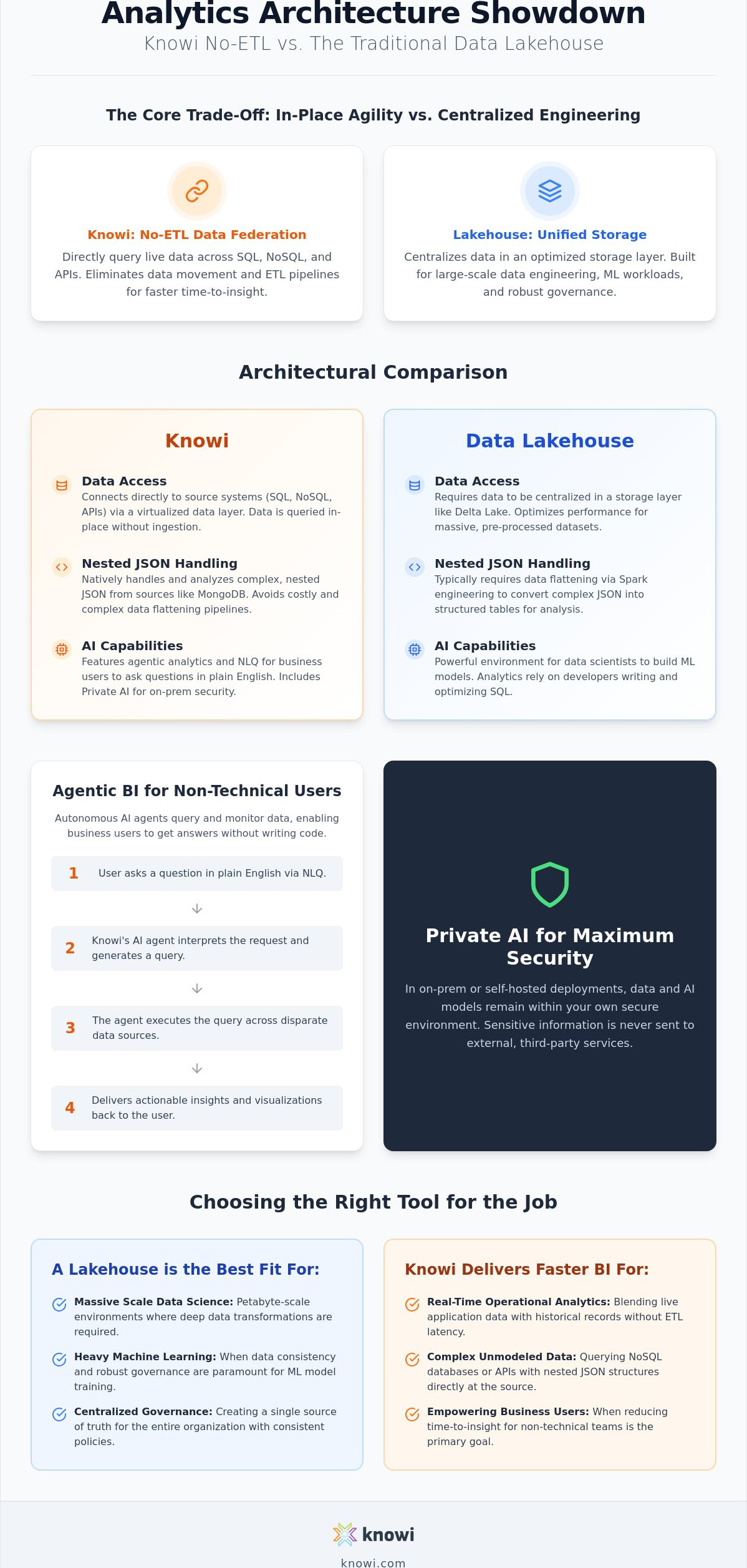
Architecture: Databricks performs best when data is in Delta Lake but can connect to external systems via Lakehouse Federation. Knowi is a No-ETL platform that uses a virtualized layer to query and join data from disparate SQL, NoSQL, and API sources in place.
-
AI Approach: Databricks AI tools, like the Databricks Assistant and Genie, operate on data within the Lakehouse. Knowi’s AI agents are designed to reason across and join data from multiple external sources, including operational databases like MongoDB and Elasticsearch.
-
JSON Handling: Databricks can process nested JSON using Spark SQL, but it often requires modeling into structured tables for BI consumption. Knowi natively queries and visualizes nested JSON from sources like MongoDB without flattening or pre-processing.
-
Ideal Use Case: The highest ROI is often achieved using Databricks for the foundational data lake and engineering, with Knowi serving as the agile, AI-driven analytics and consumption layer on top.
Table of Contents
Comparing Databricks Lakehouse and Knowi No-ETL Architectures
Enterprises choosing between Databricks and Knowi must weigh the engineering depth of a unified Lakehouse against the agility of a No-ETL, agentic BI platform. The decision hinges on where your data lives and how quickly your business users need to access it. While Databricks provides a powerful foundation for centralized data, Knowi offers a virtualized layer for real-time, multi-source analytics.
This "better together" approach is increasingly common. Gartner’s 2024 Magic Quadrant for Analytics and BI Platforms highlights the growing importance of composable architectures that can adapt to diverse and distributed data sources, reducing reliance on monolithic data stacks.
Databricks and the Unified Lakehouse Model
The Databricks Lakehouse Platform combines the scalability of data lakes with the performance of data warehouses. Its architecture, built around Delta Lake, provides a reliable, high-performance foundation for data science, machine learning, and SQL analytics. For optimal performance, data is typically ingested and stored within this ecosystem.
However, Databricks is not a closed system. Features like Lakehouse Federation allow users to query data in external sources like PostgreSQL and MySQL without moving it, extending the reach of the platform. This makes Databricks a robust central hub for data governance and large-scale computation, even in a federated environment.
Knowi and the Virtualized Data Layer
Knowi takes a different architectural approach, focusing on data consumption without centralization. As a No-ETL platform, it connects directly to over 70 sources, including Databricks SQL, MongoDB, and REST APIs, querying data in place. This virtualized data layer eliminates the operational complexity and latency associated with traditional ETL pipelines.
This is particularly effective for hybrid architectures. An organization can use Databricks to manage its core data assets while using Knowi to connect to Databricks SQL alongside live operational NoSQL databases or APIs. This allows business users to generate insights from a combination of historical and real-time data without waiting for engineering teams to build new pipelines.
Databricks AI/BI and Genie Explained
Databricks has heavily invested in generative AI to simplify analytics within its ecosystem. Its suite of tools, including the Databricks Assistant, AI/BI Dashboards, and the underlying intelligence engine often referred to as Genie, is designed to streamline workflows for data professionals working with data inside the Lakehouse.
The Databricks Assistant functions as a context-aware AI companion that helps users write code, generate queries, and debug errors. AI/BI Dashboards allow users to describe their desired outcome in natural language, and the system automatically generates the necessary queries and visualizations. These tools are powerful accelerators for tasks performed on data that is already governed and stored within Databricks.
The Scope of Databricks AI
The primary function of Databricks AI is to enhance productivity and accessibility for data stored in Delta Lake or connected via Lakehouse Federation. It excels at translating natural language into complex Spark SQL and Python, building dashboards, and explaining code. Its operational scope is intentionally focused on the Databricks environment, making it a highly effective tool for analysts and engineers working within that platform.
Knowi Agentic BI vs. Databricks SQL Analytics
While Databricks AI focuses inward on the Lakehouse, Knowi’s Agentic BI is designed to reason outward, across a distributed data landscape. An AI Data Agent in Knowi is an autonomous system that can understand business questions, identify the correct data sources (whether they are in Databricks, MongoDB, or an API), execute queries, and deliver insights proactively.
This differs from a traditional SQL workbench or a chatbot wrapper. Knowi’s agents use a semantic layer to understand business logic and can perform cross-source joins on the fly. User reviews on platforms like G2 often highlight ease of use for non-technical users as a key factor in BI tool adoption, an area where agentic interfaces show significant promise.
The Role of AI Data Agents in Modern Analytics
Knowi’s AI agents extend beyond simple natural language querying. They can be configured to monitor Key Performance Indicators (KPIs) autonomously, alerting users in Slack or Microsoft Teams when a metric deviates from its predicted path. This transforms analytics from a reactive, manual process into a proactive, automated one.
This approach complements the developer-centric experience of Databricks SQL. While a data analyst can use Databricks to write highly optimized queries against the Lakehouse, a business user can use Knowi’s natural language BI to ask a question that joins that same Lakehouse data with a live feed from a separate operational system, getting an answer in seconds.
Analyzing Complex Data: Nested JSON and NoSQL
A critical differentiator between analytics platforms is their ability to handle semi-structured and unstructured data, such as nested JSON from NoSQL databases or APIs. This is a common challenge for IoT, application logging, and SaaS data, where schemas evolve rapidly.
Databricks handles complex data types, including JSON, through Spark SQL’s powerful functions like from_json. However, for business users to consume this data in a BI tool, it typically requires modeling and structuring by a data engineer to create a clean, tabular view. This modeling effort ensures performance and usability but can introduce delays between data availability and insight generation.
Native NoSQL Support in Knowi
Knowi is built to handle nested data structures natively, eliminating the need for pre-processing. When connecting to a source like MongoDB or Elasticsearch, it preserves the data’s original hierarchy. This allows users to perform search-based analytics directly on raw, unmodeled JSON blobs.
The platform’s most powerful capability is joining this NoSQL data with structured data from other sources. For example, a user can create a single query that joins a customer collection in MongoDB with a sales table in a Databricks Delta table. This ability to analyze data across structural boundaries without a complex data pipeline is a core advantage of Knowi’s architecture.
Deployment Security: Private AI vs. Cloud-Native
Data security and sovereignty are paramount for enterprises, especially in regulated industries like finance and healthcare. Both Databricks and Knowi offer robust security controls, but their deployment models provide different levels of flexibility and data privacy for AI features.
Databricks is primarily a cloud-native platform, available on Azure, AWS, and GCP. It provides extensive security features within these cloud environments, and both platforms maintain SOC 2 and HIPAA compliance. Knowi, however, offers cloud, on-premise, and hybrid deployment options, providing more flexibility for organizations with strict data residency requirements or air-gapped environments.
Data Sovereignty in Private AI Deployments
The distinction becomes critical with the rise of AI. Knowi’s Private AI deployments allow an organization to use its powerful natural language and agentic features while ensuring that no data or queries are sent to third-party LLM providers. By integrating with local, self-hosted LLMs, Knowi ensures that sensitive data never leaves the user’s private network (VPC) or on-premise servers.
This is a key requirement for sectors that cannot risk exposing personally identifiable information (PII) or proprietary data to external services. It enables secure use cases like embedded analytics in SaaS applications where multi-tenant data privacy is non-negotiable.
Decision Framework: Knowi vs. Databricks
Choosing the right tool depends on your primary goal: building a foundational data engineering platform or deploying an agile, multi-source analytics layer for business users. The following tables provide a clear framework for making this decision.
Pricing Models Compared
The two platforms follow fundamentally different pricing philosophies. Databricks operates on a consumption-based model, charging based on Databricks Units (DBUs) consumed for compute resources. Knowi typically uses a flat-rate or custom pricing model based on features and use cases, offering more predictable costs for analytics workloads.
Choose Your Platform
| Scenario | Choose Databricks If… | Choose Knowi If… |
|---|---|---|
| Primary Goal | You are building a centralized, large-scale data engineering and machine learning platform. Your priority is processing and storing massive datasets efficiently. | You need to provide business users with self-service analytics on data scattered across multiple SQL, NoSQL, and API sources without moving it. |
| Data Structure | Your data is primarily structured or can be modeled into structured tables within Delta Lake for optimal query performance. | You work extensively with nested JSON from sources like MongoDB or Elasticsearch and need to analyze it without a flattening or modeling phase. |
| AI & Analytics Users | Your users are data scientists, analysts, and engineers who are comfortable working within a unified platform and using AI to accelerate code and query generation. | Your users are non-technical business stakeholders who need to ask questions in natural language and receive proactive alerts from AI agents monitoring data across the company. |
| ETL Strategy | You have an established data engineering team to manage data ingestion and transformation pipelines to populate the Lakehouse. | You want to minimize data pipeline maintenance and provide immediate access to live, operational data by querying it directly at the source. |
| Deployment Needs | You are standardized on a major cloud provider (AWS, Azure, GCP) and your security requirements are met by a cloud-native architecture. | You require an on-premise, hybrid, or private cloud deployment to meet strict data sovereignty regulations or need a Private AI implementation. |
Where Knowi Fits Best in the Enterprise Stack
Databricks remains an industry leader for large-scale data engineering, machine learning, and unified lakehouse storage. It provides an unparalleled foundation for managing data at scale. However, for the analytics and consumption layer, a different set of capabilities is required to bridge the gap between that powerful foundation and the business users who need immediate insights.
Knowi is the superior choice for organizations requiring real-time, multi-source joins, native NoSQL analytics, and agentic BI without ETL. It acts as an agile access layer that empowers non-technical users while reducing the modeling effort for data teams. If your data is 100% structured in a single cloud warehouse and you have no NoSQL or real-time API needs, a traditional BI tool may suffice.
Integrating Knowi with Databricks SQL
Enterprises often find the highest ROI by using both platforms together. In this model, Databricks serves as the high-performance data lake, handling massive data processing and storage. Knowi connects to Databricks SQL as one of its many data sources, leveraging its caching layer to reduce Databricks compute costs while providing a unified interface for joining that data with other operational systems.
This hybrid approach delivers the best of both worlds: the engineering rigor of the Databricks Lakehouse and the business agility of Knowi’s agentic, No-ETL analytics platform. Experience how agentic analytics can transform your multi-source data workflows without the need for complex ETL. Request a demo to see how Knowi connects to your specific data stack.
Frequently Asked Questions
Is Knowi better than Databricks for business intelligence?
Knowi is specialized for multi-source, No-ETL business intelligence, particularly with NoSQL and API data. Databricks provides a broader data platform that includes BI capabilities (Databricks SQL) but excels at data engineering and ML. Many use Knowi as the analytics layer on top of Databricks.
Can Knowi connect directly to Databricks SQL without ETL?
Yes, Knowi has a native connector for Databricks SQL. It allows you to query data directly in your Databricks Lakehouse and join it with other sources without needing to move or duplicate the data.
What is the difference between agentic BI and traditional BI?
Traditional BI relies on users manually building queries and dashboards. Agentic BI, like in Knowi, uses autonomous AI agents that can understand natural language questions, proactively monitor data for anomalies, and automate the delivery of insights.
Does Knowi support native MongoDB analytics?
Yes, Knowi provides native analytics for MongoDB. It can query nested JSON data directly within MongoDB collections without requiring users to flatten the data or use a separate connector like the MongoDB BI Connector.
Can I deploy Knowi on-prem for better data security?
Yes, Knowi offers flexible deployment options, including on-premise, in your own private cloud (VPC), or as a managed cloud service. On-premise deployments ensure your data never leaves your environment.
How does Knowi handle nested JSON data compared to Databricks?
Knowi queries nested JSON natively, preserving its structure for analysis. Databricks can process JSON with Spark SQL, but it often requires data engineers to model it into a tabular format before it can be easily used in dashboards by business users.
What are the primary use cases for Private AI in analytics?
Private AI is for organizations in regulated industries like healthcare and finance that need to use AI for analytics without exposing sensitive data to third-party services. It allows natural language queries and AI features to run entirely within the customer’s secure network.