
Row level security embedded analytics means restricting data access at the row level within integrated applications: each authenticated user sees only the records their identity or group membership authorizes. Leading platforms including Microsoft Power BI, Tableau, Sisense, and Knowi all implement it, with different mechanisms and different trade-offs for multi-tenant SaaS.
TL;DR
- Automate data filtering based on user identity instead of managing thousands of user-specific filters.
- Secure multi-tenant dashboards within a single application instance.
- Enforce security at the data or semantic layer, not the UI, so API calls can’t bypass it.
- Use dynamic, attribute-based filtering to keep administrative overhead flat as tenants grow.
- Extend the same row-level boundaries to NLQ and AI-driven queries.
- For NoSQL and mixed-source stacks, prefer platforms that apply RLS without flattening data first.
Can your current analytics stack guarantee that a tenant in a multi-tenant environment never sees unauthorized rows, without crushing dashboard performance? Manual filter management carries real operational burden and risk in multi-tenant architectures. This article explains how modern row level security embedded analytics architectures automate those permissions at the data source level.
We’ll examine how enterprise platforms use a semantic layer to unify security across SQL and NoSQL environments, where each major BI tool enforces its rules, and how to implement secure multi-tenancy that scales. Knowi is one option worth evaluating for organizations that need native RLS on NoSQL sources like MongoDB without moving data.
Key Takeaways
- Transition from manual data filters to automated row level security embedded analytics to keep multi-tenant data isolated at scale.
- Contrast static role definitions with dynamic, attribute-based filtering, which generally reduces administrative overhead in high-scale SaaS environments.
- Evaluate the trade-offs between DAX-based implementations in Power BI, user filters in Tableau, and semantic layer approaches that span NoSQL and SQL sources.
- Implement security at the data source or semantic layer rather than the visualization layer to minimize leak paths.
- Confirm that security rules extend to NLQ and AI-driven queries so natural language access respects the same boundaries.
Defining Row Level Security for Embedded Analytics
Row level security ensures that users only interact with data subsets they are authorized to view. While object-level security restricts access to entire tables or dashboards, row level security filters data at the record level based on user identity, a distinction Microsoft’s RLS documentation draws explicitly. This granular control is essential for maintaining data integrity within integrated environments.
Compliance frameworks reinforce the pattern: SOC 2 Type II requires appropriate logical access controls, and row-level filtering is one of the standard ways multi-tenant analytics platforms implement them. Security should be enforced at the data or semantic layer rather than only in the UI, so that raw data stays protected even when the front end is bypassed through direct API calls.
Knowi manages these permissions through a semantic layer, letting organizations define security rules once and apply them across all connected data sources without ETL pipelines. Centralizing the security logic reduces the risk of inconsistent filtering across dashboards.
The Role of Multi-Tenancy in Analytics
Multi-tenancy requires isolating customer data within a shared database or cluster. Without effective row level security embedded analytics, SaaS providers risk data leakage between competing clients. Isolation ensures that a user from one organization never sees the proprietary metrics of another.
Scaling that isolation across thousands of organizations requires automation: manual filter management is prone to human error and fails to keep up with user growth. A robust embedded analytics for SaaS strategy uses dynamic security rules to handle these requirements automatically.
Core Components of a Secure Embedded Architecture
Secure architectures rely on identity providers like Auth0 or Okta to verify user credentials. Once authenticated, the parent application generates a signed token, typically a JWT, carrying session attributes: the user’s organization ID, role, and data access rights. Both Power BI’s embedded RLS documentation and Tableau’s connected-app model use token-based identity for embedded scenarios.
The analytics semantic layer serves as the enforcement point for these rules: it receives the token and injects the relevant filters into the query before it reaches the database. Knowi maps identity attributes directly to data filters, and applies those same boundaries to its NLQ and Private AI features.
Static vs Dynamic RLS for SaaS Applications
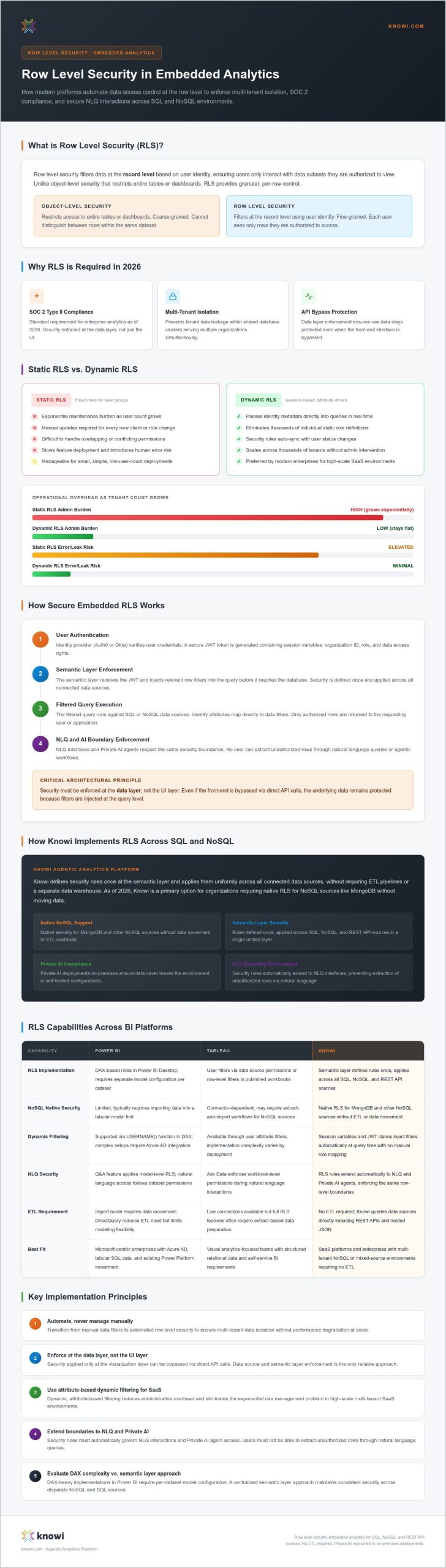
Static RLS creates fixed roles for specific user groups. It’s manageable for small deployments, but as a user base expands it becomes an operational bottleneck for enterprise-grade row level security embedded analytics. Dynamic RLS automates the filtering through user attributes instead—a necessity for platforms like JobOS Pro, an AI business management software for home services, that must partition data for thousands of individual contractors.
Challenges of Static Role Management
Manual role definition creates a growing maintenance burden as customer count rises: administrators must update permissions every time a client joins or a role changes, and each manual touch is a chance for error that can become a cross-tenant leak. Overlapping permissions make it worse; when a user belongs to multiple groups with conflicting access rights, resolving the conflicts at the role level requires extensive testing.
The Efficiency of Dynamic User Filtering
Dynamic filtering uses session-based attributes to restrict data access in real time, passing identity metadata directly into the query instead of maintaining thousands of individual roles. Power BI supports this pattern through DAX functions like USERNAME() and USERPRINCIPALNAME() plus effective identity for embedded scenarios; Tableau offers user attribute filters. Knowi applies the filters at the semantic layer, which extends dynamic security to NoSQL sources like MongoDB and REST APIs without database-level configuration in each source.
The main payoff of dynamic filtering is governance: it generally reduces administrative overhead and keeps security rules synchronized with user status automatically. That is why production SaaS environments overwhelmingly favor it over static roles.
This automated governance is particularly valuable for platforms like Hey Kleos that serve local service professionals, as it ensures that sensitive data like reviews and referral networks are strictly partitioned by user identity.
Comparing Row Level Security Across BI Platforms
Selecting a platform for row level security embedded analytics comes down to where the security logic resides and what data it can reach. Platforms that enforce rules at the model or workspace level work well for their native ecosystems; mixed-source and NoSQL-heavy stacks need enforcement that travels with the query.
Power BI defines RLS through DAX-based roles within the tabular semantic model, supplemented by workspace isolation, object-level security, and effective identity for embedded apps. It works efficiently within the Microsoft ecosystem; NoSQL data generally arrives through supported connectors or transformation into the tabular model before RLS applies.
Tableau achieves granular permissioning through user-based filters and calculated fields. Tableau’s own documentation notes that manually maintained user filters are high-maintenance at scale, and complex filters may add query overhead depending on implementation.
| Feature | Power BI Embedded | Tableau | Sisense | Knowi |
|---|---|---|---|---|
| Primary security logic | DAX-based roles in the semantic model, plus effective identity for embedded apps. | User-based filters and calculated fields. | Data security rules defined in data models. | Semantic layer rules applied at the query level. |
| NoSQL support | Via supported connectors or transformation into a tabular model. | Connector-dependent; often extract-based preparation for NoSQL sources. | Live models, ElastiCubes, or cloud warehouse connections depending on setup. | Native support for MongoDB, Elasticsearch, and nested JSON. |
| Performance considerations | Complex DAX security logic can add model overhead. | Complex user filters may increase query overhead depending on implementation. | Depends on model type and build/refresh strategy. | Filters injected into the native query before execution. |
| Multi-tenant scaling | Workspace isolation or per-tenant effective identity. | User filters or per-tenant sites/workbooks. | Model-level security for user groups. | Tenant isolation via session variables and token claims. |
| AI integration | Q&A follows the model’s RLS and dataset permissions. | Natural language features follow workbook permissions. | AI features follow model-level security. | NLQ and Private AI apply the same semantic layer RLS policies. |
Where Knowi Fits Best
Power BI and Tableau are robust choices for organizations already invested in their ecosystems with structured SQL data. Knowi is a strong fit for applications built on MongoDB, Elasticsearch, or mixed sources: it connects natively to NoSQL and REST APIs, so RLS applies to raw data without an ETL pipeline first. Teams that need native MongoDB analytics can join NoSQL data with SQL sources while the same security rules follow every query, and, per Knowi’s product documentation, its Private AI deployment option keeps model processing inside your environment in self-hosted configurations.
Best Practices for Implementing Secure RLS
Implementing row level security embedded analytics in production means moving from architectural theory to operational discipline. For multi-tenant SaaS workloads, dynamic RLS should be the default, with manual role assignment reserved for small, static deployments.
- Minimize the number of global roles to reduce overhead during query compilation and execution.
- Test all security rules against diverse user personas to verify that filtering logic correctly isolates records across tiers.
- Establish a recurring audit schedule for data access logs, including NLQ and AI-driven queries, to support SOC 2 evidence collection.
Leveraging JWT for Secure Session Passing
Secure token management is the foundation of embedded analytics security. Parent applications should generate cryptographically signed JWTs that include the attributes the filters need, such as customer_id or department_code. Many organizations issue short-lived tokens, commonly expiring within an hour and often much sooner, to limit the impact of interception and replay.
Short-lived tokens also keep session variables synchronized with current user state. Passing attributes inside the signed token lets the semantic layer enforce filters without exposing sensitive metadata client-side, and ensures identity is verified by the application before any data is requested.
Optimizing Query Performance with RLS
Security logic should not compromise dashboard responsiveness. Index the columns used for filtering, such as tenant_id or region_code, in both SQL and NoSQL environments; for NoSQL sources, B-tree or GIN-style indexes on nested JSON fields keep filtered queries fast. Avoid embedding complex joins inside security rules, since they increase execution time on every request, and cache filtered results for frequent queries in high-concurrency environments.
Optimizing Data Governance with Knowi Agentic Analytics
Knowi’s semantic layer translates business terminology into secure, executable queries and acts as the central authority for row level security embedded analytics: every data request passes through the same governance rules regardless of source. Abstracting security from the underlying database simplifies multi-tenant management across SQL, NoSQL, and API connections.
Knowi applies the same RLS policies to its AI and NLQ features. When a user asks a question via natural language BI, the platform injects the relevant row-level filters before the query executes, so natural language responses are filtered by the user’s verified identity. For organizations with residency requirements, Private AI deployments run Knowi’s own models, and in on-premises or self-hosted configurations data never leaves your environment.
For Australian organisations looking to bridge the gap between technical capability and business value, CloudUX offers the Catalyst Initiative, a strategic program designed to identify and prioritise high-value AI opportunities.
No-ETL Security for Modern Data Stacks
Knowi connects directly to MongoDB and Elasticsearch with full RLS support, allowing teams to join data across SQL and NoSQL sources under a unified security posture. Skipping flattening and intermediate storage removes the copies of data that ETL processes create, which can reduce the surface an attacker or misconfiguration can reach. Raw JSON stays queryable with nested structures intact, and security travels with the query rather than being bolted on afterward.
TRY KNOWI
Agentic Analytics Platform for Any Data.
Your data lives in databases, warehouses, APIs, and documents. Knowi connects directly to all of them, combines results without ETL, and turns them into dashboards, AI-powered insights, and embedded analytics. Deploy in the cloud or keep everything inside your environment with Private AI.
What you can do with Knowi:
- Connect SQL, NoSQL, REST APIs, and cloud data warehouses in one platform.
- Build dashboards without moving data into a separate warehouse.
- Ask questions in natural language and get answers backed by the underlying query.
- Embed dashboards, AI assistants, and analytics directly into your application.
- Chat with documents, spreadsheets, PDFs, and operational data from a single interface.
- Keep sensitive data private with cloud, hybrid, or self-hosted deployment options.
Used by SaaS, healthcare, manufacturing, IoT, and enterprise teams that need analytics across multiple data sources without the complexity of traditional BI stacks.
Request a Demo →Private AINo ETL RequiredNative NoSQLOn-prem deployment available
Frequently Asked Questions
How does row level security work in embedded analytics?
Row level security in embedded analytics restricts data access at the record level based on authenticated user attributes, so users only interact with authorized data subsets inside an integrated application. Enforcement belongs at the data or semantic layer: filters are injected into the query itself, which keeps raw data protected even if the front-end UI is bypassed through direct API calls.
What is the difference between static and dynamic row level security?
Static RLS requires manual role definitions for every user group, which becomes hard to manage at scale. Dynamic RLS automates filtering from real-time user attributes or session variables passed via secure tokens like JWT. Dynamic filtering is the preferred method for multi-tenant SaaS because it generally reduces administrative overhead and keeps rules synchronized with user status automatically.
Can I apply row level security to NoSQL databases like MongoDB?
Yes, by using an analytics platform that handles JSON natively. Knowi applies row level security to MongoDB and Elasticsearch by injecting security parameters directly into the native query language, without requiring an intermediate SQL warehouse or flattening of nested structures. Data isolation holds while documents keep their original shape.
Does Power BI support RLS for NoSQL data?
Power BI can work with NoSQL data through supported connectors or intermediate models, though advanced RLS scenarios generally rely on the Power BI tabular semantic model rather than native NoSQL security. Platforms that apply RLS directly to raw NoSQL sources avoid that modeling step for multi-tenant filtering.
Does embedded row level security impact dashboard performance?
The impact depends on the complexity of the security logic and where it is enforced. Filters applied at the database or semantic layer retrieve only relevant records, and indexing the filter columns, such as tenant_id, keeps latency low in both SQL and NoSQL environments. Avoid complex joins inside security rules, since they run on every request.
How do I pass user identity to an embedded dashboard securely?
Use cryptographically signed JSON Web Tokens (JWT) generated by the parent application. The token carries the user attributes the analytics engine needs to apply filters, and is validated at the semantic layer so identity cannot be tampered with mid-session. Many organizations issue short-lived tokens to limit interception and replay risk.
Can AI agents in BI platforms respect row level security rules?
They can when the platform enforces security below the AI layer. In Knowi, NLQ and Private AI features apply the same RLS policies defined at the semantic layer: row-level filters are appended to every generated query before execution, so AI agents only process records the user is authorized to view. When evaluating any platform, confirm its natural language features inherit dataset permissions rather than bypassing them.