
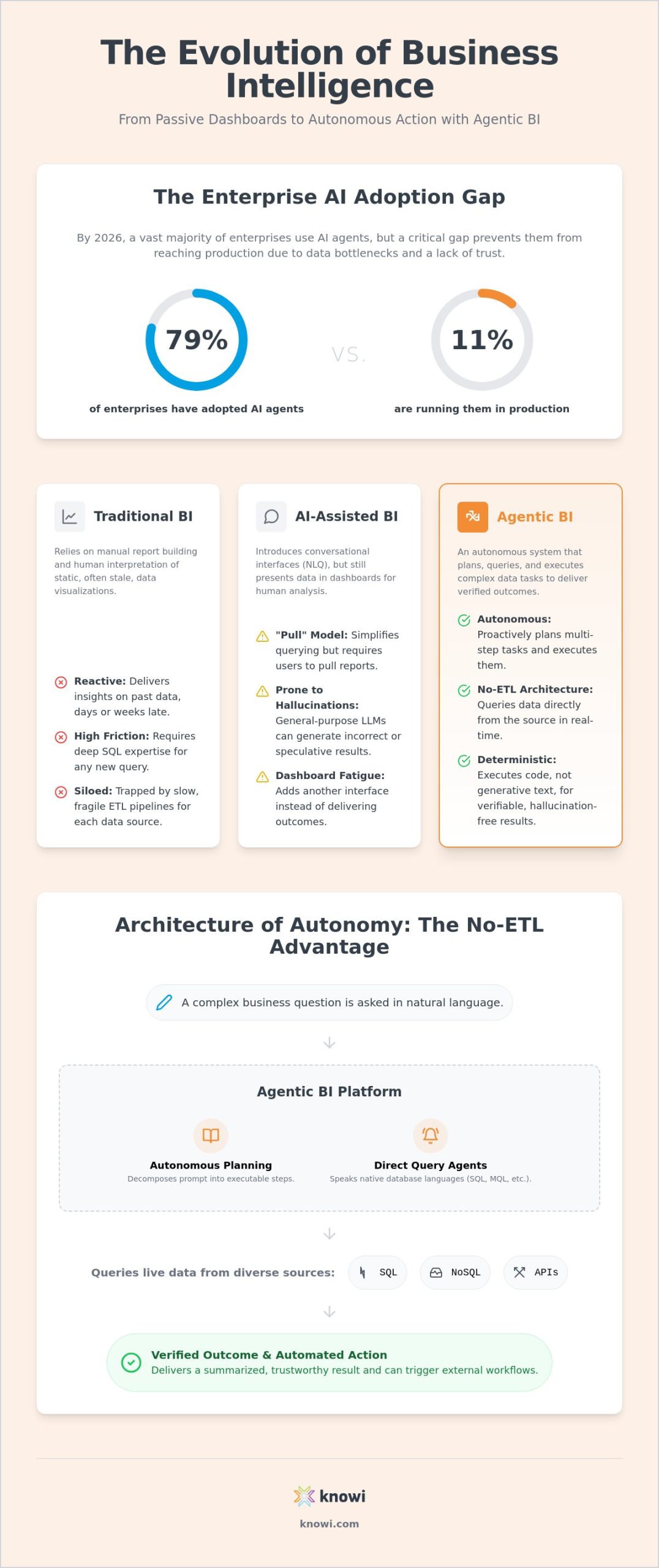
In 2026, 79% of enterprises have adopted AI agents in some form, yet only 11% are currently running them in production. This massive gap exists because most organizations remain trapped in a cycle of waiting weeks for ETL pipelines to update or struggling with hallucinations from general-purpose LLMs. You likely recognize the frustration of staring at a dashboard that requires endless manual filtering to find a single actionable truth. A sophisticated agentic BI platform changes this dynamic by shifting the focus from passive visualization to autonomous execution.
Discover how these platforms move beyond simple conversational interfaces to provide real-time insights across both SQL and NoSQL environments without the need for traditional data movement. We’ll explore how to implement autonomous reporting workflows that satisfy strict compliance through secure, private AI deployments. This guide defines the new standard for decision intelligence; it provides a roadmap for transforming your data stack into a self-correcting, high-velocity asset that prioritizes both speed and data integrity.
Key Takeaways
- Define the shift from passive dashboards to autonomous systems that independently plan and execute complex data tasks.
- Learn how an agentic BI platform eliminates ETL bottlenecks by querying diverse data sources directly using native database languages.
- Address data integrity concerns by replacing generative text with deterministic code execution to ensure verifiable, hallucination-free results.
- Operationalize decision-making by integrating AI agents that trigger external workflows and provide embedded analytics within SaaS applications.
- Deploy secure, private AI environments that maintain strict enterprise compliance while unifying insights across SQL and NoSQL architectures.
Beyond Passive Dashboards: Defining the Agentic BI Platform
The traditional business intelligence model is reaching its technical limit. For decades, BI focused on visualization, requiring humans to interpret charts, apply filters, and manually bridge the gap between a data point and a business decision. An agentic BI platform represents a fundamental shift in this architecture. It’s an autonomous system designed to plan, query, and execute complex data tasks without constant human intervention. While “Traditional BI” relies on manual report building and “AI-Assisted BI” offers simple natural language interfaces, agentic systems move into the realm of execution. They don’t just show you that churn is increasing; they identify the root cause across disparate datasets and trigger the necessary workflows to mitigate it.
By 2026 standards, decision intelligence requires more than just speed. It demands autonomy and cross-source compatibility. Modern organizations can’t afford to wait for data engineering teams to build new pipelines every time a business question evolves. To understand the broader context of this shift, one must look at What is Decision Intelligence? and how it integrates social science and managerial science into technical frameworks. Agentic BI serves as the execution layer for this discipline, transforming raw data into verified organizational outcomes through specialized agents that understand the nuances of both SQL and NoSQL environments.
The Shift from Interfaces to Outcomes
Modern enterprises are currently battling dashboard fatigue. Most executives don’t want another interface to navigate; they want the result of the analysis delivered where they already work. Agentic BI replaces manual filtering with proactive alert-to-action cycles. Instead of a user spotting a trend and then manually investigating, an autonomous agent plans the multi-step request. It queries the database, validates the result against historical benchmarks, and provides a summarized recommendation. This move from “pulling reports” to “receiving outcomes” allows leadership to focus on strategy rather than data discovery.
Why Passive BI Fails the Modern Enterprise
Passive BI systems are inherently reactive, often delivering “stale data” that is days or weeks behind the current market reality. This latency stems from the heavy reliance on traditional ETL pipelines that require constant maintenance. The friction of needing deep SQL expertise for every new query creates a bottleneck that slows down the entire organization. An agentic BI platform reduces this burden on data engineering teams by using direct-query agents. These agents speak native database languages, allowing for real-time analysis without the overhead of data movement. This architecture ensures that security and privacy remain intact while providing the agility required for 2026’s high-velocity markets.
- Autonomous Planning: Agents decompose complex prompts into executable data steps.
- Cross-Source Unification: Seamlessly join data from MongoDB, Snowflake, and APIs in one step.
- Deterministic Reliability: Systems prioritize code-based execution over speculative text generation.
The Architecture of Autonomy: Querying Without ETL
The most significant bottleneck in modern analytics isn’t the visualization of data; it’s the movement of it. Traditional ETL pipelines are fragile, expensive, and slow. A sophisticated agentic BI platform bypasses this entire infrastructure by utilizing a No-ETL architecture. Instead of extracting, transforming, and loading data into a centralized warehouse, agents act as intelligent translators. They utilize “Direct Query” capabilities to communicate with databases in their native tongues, whether that’s SQL for relational systems or MQL for document-based stores. This direct interaction ensures that the data analyzed is always the most current version available in the source system.
This autonomy is powered by a Virtual Data Layer. This execution environment unifies data in-memory for the duration of a query without requiring persistent storage in a secondary location. It allows an agent to execute a complex aggregation in MongoDB and simultaneously pull historical records from Snowflake, joining them instantly. Industry leaders recognize decision intelligence as a top strategic trend because it moves organizations away from “mystical” data science toward mundane, repeatable execution. By removing the friction of data movement, enterprises can finally achieve the agility that 2026 markets demand. To experience this architectural shift firsthand, you can start a Free Trial of our production-ready analytics engine.
Native Connectivity to NoSQL and APIs
NoSQL databases like MongoDB and Elasticsearch present persistent challenges for traditional BI tools due to their semi-structured nature. Agentic BI platforms excel here. Agents autonomously parse complex JSON structures and handle dynamic schemas without requiring a flattened relational table. This capability extends to real-time API integration. Agents can pull live data from services like Salesforce or HubSpot and combine it with internal database records on the fly. This provides operational reporting that reflects the exact state of the business at any given second, rather than a snapshot from the last warehouse refresh.
Autonomous Data Joins and Transformation
The complexity of joining disparate datasets often consumes the majority of a data engineer’s time. Agents simplify this by identifying related entities across different schemas automatically, even when primary keys aren’t explicitly defined. No-ETL Agentic Joins are the ability to merge disparate datasets in-memory without persistent storage. By automating schema mapping and join logic, industry benchmarks suggest organizations can reduce data engineering overhead by up to 80%. This automation allows technical teams to shift their focus from pipeline maintenance to high-level data strategy and governance.
Solving the Trust Gap: Deterministic vs. Generative Analytics
The primary obstacle to widespread AI adoption in analytics is the trust gap. Stakeholders can’t afford a probabilistic guess when making high-stakes decisions. Traditional generative AI models often hallucinate numbers because they predict the next word in a sequence rather than executing a logical operation. A high-performance agentic BI platform solves this by shifting from generative text to deterministic execution. In this model, the agent generates verified code, such as SQL or MQL, which runs directly against your data source. This ensures that the result is a calculation, not a prediction. You get the speed of AI with the precision of a hand-written query.
Confidence in these results is further anchored by a robust semantic layer. By defining business logic in a centralized repository, you ensure that every agent understands exactly what “Revenue” or “Customer Lifetime Value” means. This metadata serves as a map for the agent. It allows the system to navigate complex enterprise schemas without making assumptions, which eliminates the risk of different departments receiving conflicting answers to the same question. When the agent knows the data model through this layer, it doesn’t have to guess which tables to join or which filters to apply.
The Role of the Semantic Layer
A governed semantic layer acts as the single source of truth for all autonomous operations. It allows data teams to define complex metrics and relationships once, which the agents then use to translate natural language into precise queries. This layer prevents agents from misinterpreting ambiguous field names or joining tables incorrectly. By providing this structural guardrail, the platform guarantees consistency across every use case, from executive reporting to operational alerts. This results in a unified data culture where everyone works from the same definitions.
Private AI Deployment for Data Security
For organizations in regulated industries, data privacy is a non-negotiable requirement. Sending sensitive enterprise data to public LLMs introduces unacceptable risks and often violates compliance standards. A secure agentic BI platform offers Private AI Deployment, allowing the intelligence stack to run within your own cloud or VPC environment. This architecture ensures that your data never leaves your control, which satisfies the rigorous demands of HIPAA, GDPR, and SOC2. You maintain total integrity while leveraging the full power of autonomous analytics without external data exposure. This provides the relief of streamlined operations while maintaining meticulous safety standards.
Operationalizing Agentic BI: From Insights to Automated Workflows
The true value of an agentic BI platform isn’t just the ability to answer a question; it’s the capability to act on that answer. In 2026, the gap between insight and action is the primary driver of the $7.6 billion agentic AI market. These systems don’t stop at visualization. Instead, they bridge the “last mile” of analytics by triggering external workflows through APIs and webhooks. For example, in finance, an agent can detect a fraud pattern by joining real-time transaction data with historical behavioral profiles and then immediately flag the account for review. In healthcare, agents monitor patient data across MongoDB-based EHRs and live vitals, autonomously alerting medical staff when specific physiological thresholds are breached.
High-stakes decisions still require human oversight. This is where the Human-in-the-Loop (HITL) governance model becomes essential. The agent performs the heavy lifting of data discovery and synthesis, but it presents its findings and proposed actions for human approval. This ensures that while the process is accelerated, the final accountability remains with the domain expert. This methodology transforms BI from a research tool into an operational engine that drives measurable business outcomes.
Embedded Agents for SaaS and Product Teams
Software vendors are moving away from static embedded iFrames toward API-driven “Headless BI” agents. By integrating an agentic BI platform directly into their own applications, product teams can provide white-label AI analytics without the overhead of building specialized models from scratch. This allows end-users to interact with data using natural language and receive autonomous insights within the native product environment. You can explore these capabilities by integrating Embedded Analytics into your own software ecosystem today.
Automating the Reporting Lifecycle
Manual report generation is a relic of the past. Modern agents monitor for anomalies and autonomously generate “Flash Reports” the moment a significant deviation occurs. Agents can prepare weekly QBR decks without human intervention, populating slides with the most relevant charts and narrative summaries based on the previous seven days of performance. This reduces the traditional “Time-to-Insight” from several days to mere seconds. By utilizing autonomous polling, the system ensures that leadership always has access to the most current strategic data.
The Knowi Advantage: Production-Ready Agentic BI
Knowi Enterprise Edition stands as the leading agentic BI platform for organizations that prioritize data integrity and operational speed. While legacy systems struggle with the architectural limitations of data warehousing, Knowi utilizes a No-ETL approach to deliver immediate value. The platform features over 15 specialized AI agents, including dedicated Query, Dashboard, and Widget agents. Each agent is engineered to handle specific segments of the analytics lifecycle, which ensures that complex tasks are decomposed and executed with surgical precision. This modularity allows the system to scale its intelligence as your organizational needs grow.
Modern AI stacks require seamless interoperability, which is why we’ve integrated the Knowi MCP (Model Context Protocol). This integration allows our platform to act as a sophisticated bridge between your raw data and the broader AI ecosystem. It ensures that your LLMs have the exact context they need to generate accurate, data-driven insights without the risk of hallucination. For enterprises with strict security mandates, our Private AI Deployment options provide a guardian-like level of protection. Your models and data remain entirely within your VPC, satisfying the most rigorous compliance standards while empowering your teams with cutting-edge automation.
Scalability and Multi-Source Integration
Knowi’s architecture is built on a “No-Movement” data philosophy. This means we don’t require you to migrate your information to a proprietary store to analyze it. With over 70 native data connectors, including deep, native support for NoSQL databases like MongoDB, Knowi unifies your entire stack. Whether you’re a high-growth startup or a global enterprise with petabytes of data, our platform scales to meet the demand. You gain a unified view of your business across SQL, NoSQL, and APIs without the latency or cost of traditional data movement. This architecture reinforces our identity as a stable, enterprise-grade partner that prioritizes data integrity.
Getting Started with Agentic BI
Transitioning from legacy BI to an agentic BI platform doesn’t require a total “rip and replace” of your existing infrastructure. The roadmap begins with identifying high-impact use cases where ETL latency currently hinders decision-making. From there, you can layer Knowi’s autonomous agents over your existing data sources to see immediate improvements in time-to-insight. We offer customizable pricing models tailored to the specific requirements of enterprise-grade deployments. To experience the future of decision intelligence, you can start a Knowi Free Trial and begin building your own autonomous data workflows in minutes.
Transitioning to Autonomous Decision Intelligence
The shift toward an agentic BI platform is no longer a theoretical evolution; it’s a technical necessity for the 2026 enterprise. By moving beyond static visualizations and fragile ETL pipelines, organizations can finally achieve the real-time agility required to lead in complex markets. We’ve defined how deterministic execution and a governed semantic layer solve the trust gap that previously hindered AI adoption. This architecture transforms data from a passive record into an active, autonomous participant in your business strategy.
Knowi provides the most direct path to this operational future. With 15+ specialized production AI agents and native No-ETL support for MongoDB and Elasticsearch, the platform eliminates the friction between raw data and enterprise action. You can maintain uncompromising standards through a Secure Private AI Deployment that ensures compliance while driving sophisticated workflows. It’s time to replace manual reporting with an execution layer that works at the speed of your business. Experience the future of data with a Knowi Free Trial and begin your transition to high-velocity, autonomous decision-making today.
Frequently Asked Questions
What is the difference between an AI chatbot and an agentic BI platform?
An AI chatbot primarily focuses on generating conversational text based on probabilistic patterns. In contrast, an agentic BI platform acts as an execution layer that translates natural language into deterministic code like SQL or MQL. While a chatbot might describe a trend, an agentic system autonomously plans the data retrieval, performs calculations, and can trigger external business workflows through APIs. This moves the user experience from simple conversation to verifiable operational outcomes.
Does an agentic BI platform require a data warehouse?
A data warehouse is not a prerequisite for an agentic BI platform. Sophisticated systems utilize a No-ETL architecture to query diverse data sources directly in their native environments. This approach eliminates the latency and cost associated with traditional data movement. It allows for real-time analysis across production databases without the need for a centralized, persistent storage layer, which preserves the integrity of the original data source.
How do agentic BI platforms handle data security and privacy?
These platforms prioritize security through Private AI Deployment options that keep the entire intelligence stack within your virtual private cloud. This architecture ensures that sensitive enterprise data never leaves your controlled environment or enters public training models. By maintaining data residency, organizations can leverage autonomous analytics while satisfying rigorous compliance standards like HIPAA, GDPR, and SOC2 without compromising on the speed of their decision-making processes.
Can agents join data from SQL and NoSQL databases simultaneously?
Agents can join data across SQL and NoSQL databases simultaneously using a virtual data layer. This capability allows a single query to pull relational data from Snowflake and semi-structured data from MongoDB in real-time. The agent autonomously identifies related entities across these disparate schemas. It unifies the results in-memory for the duration of the request, providing a holistic view of the business without the overhead of permanent secondary storage.
What is the role of a semantic layer in agentic analytics?
The semantic layer serves as the authoritative source of truth for all autonomous agents. It defines business logic, metrics, and relationships once, ensuring that agents consistently interpret complex terms like revenue or churn. This layer provides the necessary guardrails that prevent misinterpretation of enterprise schemas. It ensures that different departments work from a unified set of definitions, which is critical for maintaining data integrity in an automated environment.
How much data engineering is required to set up an agentic BI system?
Setting up an agentic system significantly reduces the data engineering burden by automating schema mapping and join logic. Instead of building and maintaining fragile ETL pipelines, engineers focus on defining the semantic layer and governing the AI’s access. This shift allows technical teams to spend less time on manual data movement and more time on high-level data strategy. It effectively reallocates engineering resources toward higher-value architectural tasks.
Are agentic BI platforms suitable for embedded analytics in SaaS?
Agentic BI platforms are highly suitable for embedded analytics within SaaS applications. Software vendors use these systems to provide native AI features to their end-users through API-driven, headless BI architectures. This allows product teams to offer sophisticated, white-label analytics and autonomous insights without the massive investment required to build such capabilities from scratch. It provides a shortcut to delivering high-level results within a native product environment.
How do I prevent hallucinations in agentic data reporting?
Hallucinations are prevented by utilizing a deterministic execution model where agents generate verifiable code rather than speculative text. The system translates the user’s intent into a precise database query that undergoes validation against the semantic layer. This ensures that the resulting output is a factual calculation derived directly from your data sources. It provides the exactitude required for enterprise-grade reporting and eliminates the risks associated with probabilistic AI models.