
Snowflake Cortex and Knowi solve different problems. Cortex adds AI capabilities to data that already lives inside Snowflake, while Knowi runs AI agents across your entire data estate: SQL, NoSQL, REST APIs, and Snowflake itself, with no ETL required.
Quick Summary (TL;DR)
- Snowflake Cortex is a suite of AI features (Cortex Analyst, Cortex Search, Cortex Agents, and AISQL functions) that operates on data inside Snowflake’s governance perimeter.
- Cortex Analyst answers natural language questions on structured data in Snowflake, and it requires a YAML semantic model or semantic view before it can answer anything.
- Knowi is an agentic analytics platform that queries data where it lives across 70+ sources, including MongoDB, Elasticsearch, SQL databases, REST APIs, and Snowflake.
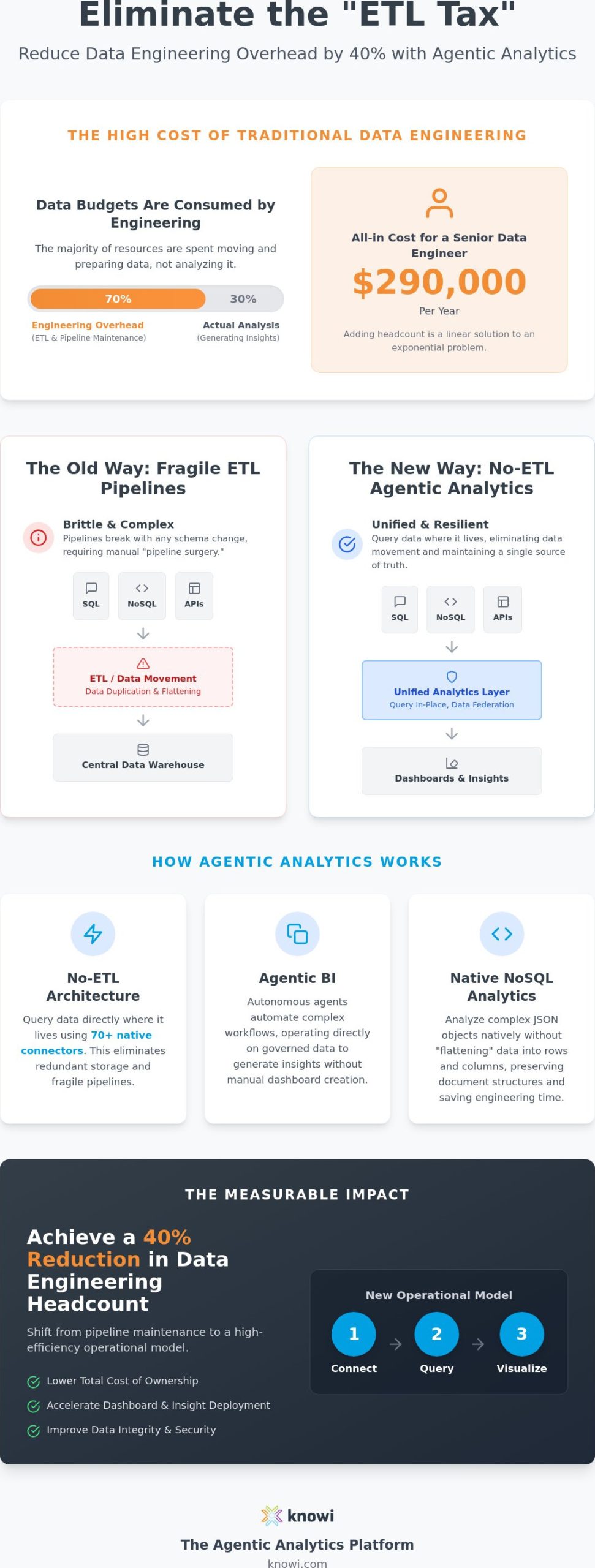
- The core difference is scope: Cortex assumes your data is already centralized in Snowflake, while Knowi joins sources together without moving data into a warehouse first.
- 2026 hiring guides put the all-in first-year cost of a senior US data engineer between $160,000 and $290,000, which is why architectures that reduce pipeline work matter financially.
- The two are not mutually exclusive: Knowi connects to Snowflake natively, so teams often use Cortex for in-warehouse AI and Knowi as the analytics layer across everything else.
Table of Contents
- What Is Snowflake Cortex?
- What Is Knowi?
- The Real Difference: AI Inside the Warehouse vs AI Across Your Data
- Snowflake Cortex vs Knowi: Side-by-Side Comparison
- What Each Approach Costs You
- Where Each Platform Fits Best
- Frequently Asked Questions
What Is Snowflake Cortex?
Snowflake describes Cortex as “a suite of AI features that use large language models (LLMs) to understand unstructured data, answer freeform questions, and provide intelligent assistance.” All models run inside Snowflake’s security and governance perimeter, so your data is not exposed to other customers or model developers. That security posture is one of Cortex’s genuine strengths.
Cortex Analyst
Cortex Analyst converts natural language questions into SQL that executes against structured data in Snowflake. It relies on semantic models: YAML files that define the logical tables, dimensions, facts, and relationships the LLM is allowed to reason over. Under the hood it selects from models including Anthropic Claude, OpenAI GPT 4.1, Arctic Text2SQL, Mistral Large 2, and Llama 3.1, all running inside Snowflake.
Snowflake’s own documentation notes real limitations. Cortex Analyst cannot access results from previous SQL queries, struggles with broad questions like “what trends do you observe,” and processing full conversation history increases cost as chats get longer.
Cortex Search and Cortex Agents
Cortex Search retrieves information from unstructured data for search and RAG use cases. Cortex Agents is a managed agentic platform that orchestrates tools in a reasoning loop: Cortex Analyst for structured queries, Cortex Search for documents, a sandboxed Python runtime, chart generation, custom stored procedures, MCP connectors, and web search. Agents are accessed through the agent:run REST API or built in Snowsight.
Cortex AISQL
AISQL puts AI functions directly into SQL: AI_COMPLETE, AI_CLASSIFY, AI_FILTER, AI_AGG, AI_EXTRACT, AI_SENTIMENT, and more. This lets analysts run sentiment analysis, classification, or document extraction on text and images without leaving a SQL statement. Usage is metered through Snowflake’s consumption-based credit model, so costs scale with how much you use it.
What Is Knowi?
Knowi is an agentic analytics platform built on a different architectural premise: query data where it lives instead of centralizing it first. It connects natively to 70+ sources spanning SQL databases, NoSQL stores like MongoDB and Elasticsearch, REST APIs, and cloud warehouses including Snowflake. Cross-source joins happen through data federation, with results combined in memory rather than staged in a warehouse.
As of July 2026, Knowi appears to be one of the few BI platforms where MongoDB, Elasticsearch, Cassandra, and DynamoDB are queried natively, without a BI connector or a flattening ETL step. On top of that data layer, natural language querying and AI agents handle question answering, dashboard creation, monitoring, and scheduled delivery to Slack, email, or Teams. For regulated teams, Knowi offers Private AI deployments where the AI runs inside your own environment, alongside SOC 2 Type II compliance and HIPAA-capable deployment options.
The Real Difference: AI Inside the Warehouse vs AI Across Your Data
Cortex’s design assumption is that your analytical data is already in Snowflake. If that’s true, Cortex gives you governed AI with zero infrastructure to manage, which is a strong position. The moment your question spans data that is not in Snowflake, you are back to building pipelines to get it there before the AI can see it.
Knowi’s design assumption is the opposite: most companies run a mix of operational databases, NoSQL stores, APIs, and one or more warehouses, and moving everything into one place is the expensive part. Here is a concrete example from our own product. To answer “which customers filed the most support tickets last month,” a Knowi user connects Snowflake (billing data) and MongoDB (ticket documents) as two datasets, joins them on customer ID in memory, and then asks the question in plain English against the joined result. No pipeline is built, and the nested MongoDB documents are never flattened into staging tables.
That pipeline work is exactly where the money goes. 2026 hiring guides estimate the all-in first-year cost of a mid-to-senior US data engineer at $160,000 to $290,000 once salary, benefits, recruiting, and ramp-up are included. Fewer pipelines to build and maintain is not an abstract benefit; it is headcount math.
Snowflake Cortex vs Knowi: Side-by-Side Comparison
| Dimension | Snowflake Cortex | Knowi |
|---|---|---|
| What it is | AI feature suite inside the Snowflake platform | Standalone agentic analytics platform |
| Data scope | Structured and unstructured data in Snowflake; Agents can reach external tools via MCP connectors and web search | 70+ native connectors: SQL, NoSQL, REST APIs, files, and warehouses including Snowflake |
| NoSQL support | Data must be loaded into Snowflake first | Queries MongoDB, Elasticsearch, Cassandra, DynamoDB natively, preserving nested structures |
| Cross-source joins | Sources must be centralized in Snowflake before joining | Federated joins across sources in memory, no staging warehouse |
| Setup requirement | Cortex Analyst requires a YAML semantic model or semantic view per domain | Connect a source and query it directly; datasets act as the governed layer |
| Natural language querying | Cortex Analyst, via API or Snowsight | Built into the platform for end users and embedded apps |
| AI agents | Cortex Agents orchestrate Analyst, Search, Python, and custom tools inside Snowflake | Agents query, monitor, alert, and deliver reports across all connected sources |
| LLM deployment | Claude, GPT 4.1, Mistral, Llama, and Arctic models hosted inside Snowflake’s perimeter | Choice of models, including Private AI deployments running in your own environment |
| Embedded analytics | Build your own app on the Cortex APIs | White-label dashboards, multi-tenant embedding, SSO out of the box |
| Compliance posture | Inherits Snowflake’s governance and security perimeter | SOC 2 Type II; HIPAA-capable and on-prem deployment options |
| Pricing model | Consumption-based Snowflake credits | Platform subscription |
What Each Approach Costs You
Cortex costs show up in two places: Snowflake credit consumption that scales with AI usage, and the engineering work to centralize any data that is not already in Snowflake. The second cost is the one that compounds, because every new source needs a pipeline, and 2026 guides put a senior data engineer’s all-in cost near the top of the $160K to $290K range at strong tech employers.
Knowi’s cost is a platform subscription, and the architectural bet is that skipping pipelines for analytics avoids some of that engineering spend. Which model is cheaper depends entirely on where your data already lives, which is why an honest evaluation starts with an inventory of your sources, not a feature list.
Where Each Platform Fits Best
Where Snowflake Cortex fits
Cortex is the natural choice when Snowflake is already your center of gravity: your data is consolidated there, your governance runs through it, and your team wants managed AI without new vendors or infrastructure. AISQL in particular is genuinely useful for analysts doing text classification or document extraction in plain SQL.
Where Knowi fits best
Knowi fits teams whose data is spread across operational NoSQL databases, SQL systems, APIs, and warehouses, and who want analytics on Snowflake alongside everything else without building pipelines first. It is also the stronger fit for SaaS companies embedding white-label analytics and for regulated industries that need Private AI running inside their own environment. Many teams run both: Cortex for in-warehouse AI workloads, Knowi as the cross-source analytics and agent layer. You can read more about the platform’s approach on the Why Knowi page.
Agentic Analytics Across Snowflake and Everything Else.
Cortex covers the data inside Snowflake. Knowi connects directly to Snowflake plus your MongoDB, Elasticsearch, SQL databases, and REST APIs, joins them without ETL, and turns the results into dashboards, AI-powered insights, and embedded analytics. Deploy in the cloud or keep everything inside your environment with Private AI.
What you can do with Knowi:
- Join Snowflake data with MongoDB, Elasticsearch, SQL, and REST APIs in a single query, no pipelines.
- Build dashboards on live sources without moving data into a separate warehouse first.
- Ask questions in natural language, with no semantic model YAML to build, and see the underlying query behind every answer.
- Embed dashboards, AI assistants, and analytics directly into your application.
- Chat with documents, spreadsheets, PDFs, and operational data from a single interface.
- Keep sensitive data private with cloud, hybrid, or self-hosted deployment options.
Used by SaaS, healthcare, manufacturing, IoT, and enterprise teams that need analytics across multiple data sources without the complexity of traditional BI stacks.
Frequently Asked Questions
Can Snowflake Cortex query data that lives outside of Snowflake?
Cortex Analyst answers questions on structured data stored in Snowflake, so analytical data generally needs to be loaded in first. Cortex Agents can reach external systems through MCP connectors and web search, but the core analytics run on data inside Snowflake’s perimeter.
Does Cortex Analyst work without a semantic model?
No. Cortex Analyst requires a YAML semantic model or a semantic view that defines the tables, dimensions, and metrics it can query. Building and maintaining these models is part of the setup cost for each data domain.
Which LLMs does Snowflake Cortex use under the hood?
Snowflake documents a mix of models including Anthropic Claude, OpenAI GPT 4.1, Arctic Text2SQL, Mistral Large 2, and Llama 3.1. All of them run inside Snowflake’s security and governance perimeter rather than on external endpoints.
Can Knowi connect to Snowflake directly?
Yes. Snowflake is one of Knowi’s 70+ native connectors, and Snowflake data can be joined with MongoDB, Elasticsearch, SQL databases, or REST APIs in a single federated query. This is why some teams use Cortex and Knowi together rather than choosing one.
Does using AI in Knowi send my data to external LLM providers?
Knowi offers Private AI deployments where the AI runs inside your own governed environment, so sensitive data does not leave your perimeter. This option exists specifically for healthcare, financial services, and other teams with data residency requirements.
How do the costs of these two approaches compare?
Cortex is billed through Snowflake’s consumption-based credit model, plus the engineering cost of centralizing any data not already in Snowflake. Knowi is a platform subscription that avoids pipeline-building for analytics, which matters when senior data engineers cost $160,000 to $290,000 all-in per year.