
No ETL business intelligence software queries data sources directly, bypassing traditional data pipelines. Leading options include platforms built on data virtualization like Denodo, Starburst, and Knowi, which offer real-time analytics without physical data movement or the need for a central data warehouse.
This approach addresses the primary bottleneck in modern analytics: data preparation and movement. By eliminating the extract, transform, and load (ETL) process, organizations can achieve zero-latency insights, reduce infrastructure costs, and empower teams to work directly with live operational data from both SQL and NoSQL systems.
TL;DR: No ETL Business Intelligence
- Direct Data Querying: No ETL BI connects directly to source systems like PostgreSQL, MongoDB, and APIs, running queries in real-time.
- Data Virtualization Layer: It uses a semantic layer to present disparate data sources as a single, unified virtual database without physically moving or replicating data.
- Eliminates Data Latency: By removing the batch ETL cycle, insights reflect the current state of the business, which is critical for operational analytics.
- Reduces ‘Data Tax’: It significantly lowers the time and cost associated with building, maintaining, and fixing brittle data pipelines.
- Native NoSQL Support: Unlike traditional BI, it can handle unstructured and semi-structured data like nested JSON from MongoDB or Elasticsearch without a flattening process.
- Agentic AI Integration: Modern platforms use Private AI agents to automate analysis, execute natural language queries (NLQ), and monitor data directly at the source.
- Lower Total Cost of Ownership (TCO): Eliminates redundant storage costs from data warehouses and reduces the need for specialized data engineering resources for reporting tasks.
The Hidden Cost of ETL-First Architectures in 2026
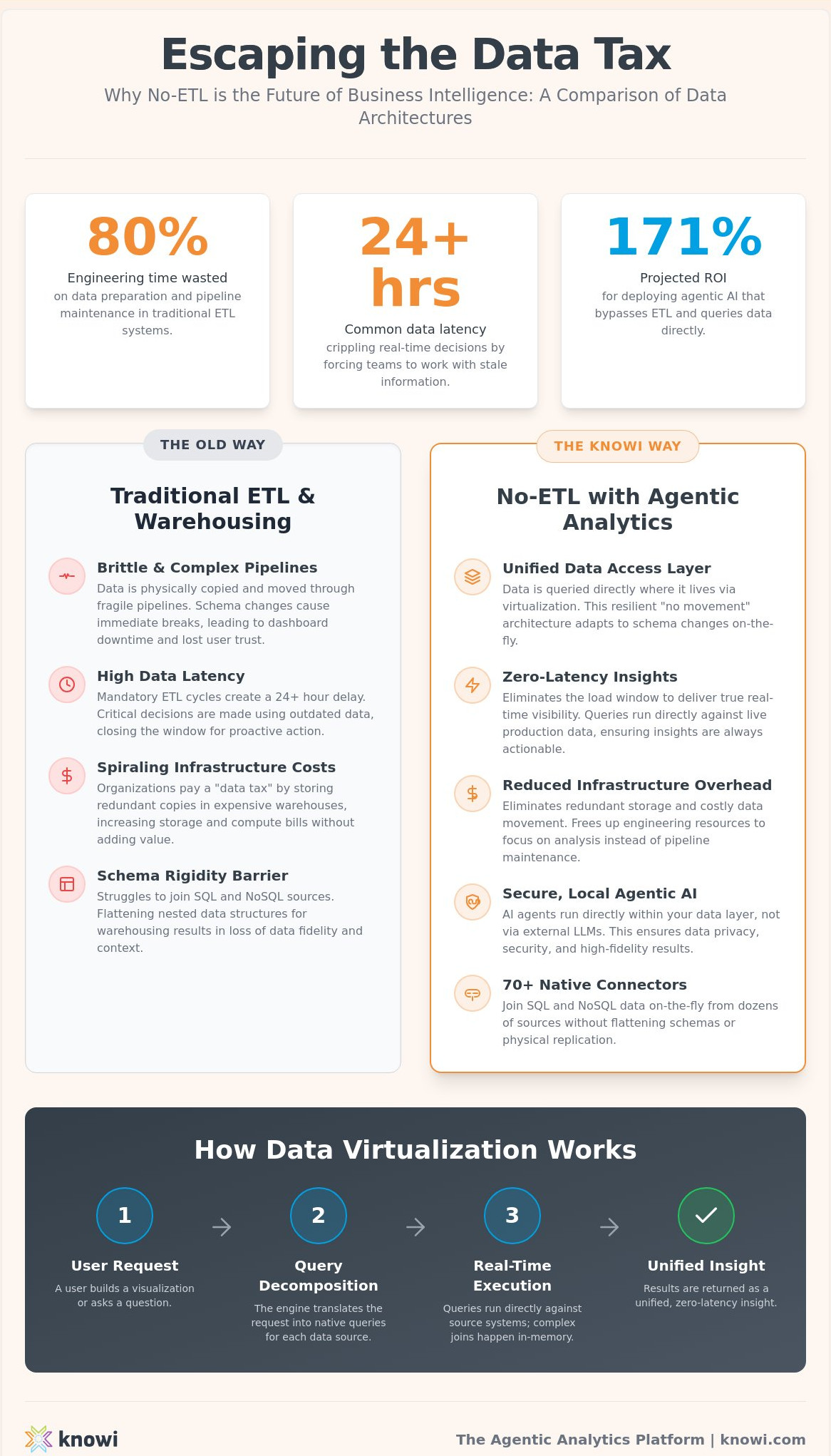
The modern data stack, once a solution, is becoming a legacy bottleneck. Its reliance on ETL creates a "Data Tax" on every analytics project, where engineering time is consumed by pipeline maintenance instead of generating insights. This architecture introduces significant latency and infrastructure costs that are no longer sustainable for agile operations.
No ETL business intelligence software offers a direct alternative. It is a system that queries data sources directly via a virtualization layer instead of requiring physical data movement into a warehouse. This fundamentally changes the analytics workflow from a multi-step, batch-oriented process to a real-time, on-demand one.
The traditional 24-hour ETL cycle cripples real-time operational reporting, making it impossible to act on immediate opportunities or threats. Furthermore, the constant replication of data into warehouses leads to infrastructure bloat, driving up the cost of storage and compute for redundant data copies.
Why Traditional Data Warehousing is Failing Modern Teams
Data warehouses introduce fragility into the analytics ecosystem. A minor change in a source API or database schema can cause a cascade of downstream failures in dashboards and reports, requiring immediate data engineering intervention. This brittleness undermines the reliability of the entire BI function.
Each data hop from a source system to a staging area and then to a warehouse increases the attack surface for sensitive information. This is a significant concern in regulated industries like healthcare and finance. The "single source of truth" promise of the warehouse often proves to be a myth, as warehouses frequently contain stale, outdated, or conflicting data due to synchronization lags.
Defining the No ETL Paradigm Shift
It is critical to distinguish between "No-Code ETL" and "True No ETL." No-Code ETL tools provide a user-friendly interface for building data pipelines but still physically move data. A true No ETL architecture, built on Data Virtualization, creates a unified data access layer that executes queries on source systems in real-time.
This unified layer is the core of the modern software architecture, abstracting the complexity of underlying data sources. No ETL BI is the elimination of physical data replication in favor of real-time, federated query execution across disparate systems.
How No ETL BI Software Actually Works: Data Virtualization
The mechanism behind No ETL BI is a powerful query virtualization engine. This engine acts as an intelligent intermediary, translating a user’s request from the BI interface into one or more native queries that are executed directly on the source systems. The results are then aggregated and returned to the user without landing the data in a separate repository.
To protect the performance of production databases, these platforms employ hybrid execution strategies. For complex operations like cross-database joins, the system can pull minimal necessary data into its own memory to perform the join, offloading the intensive computation from the source systems. This balances the need for real-time data with the imperative of maintaining operational stability.
This model uses a schema-on-read approach, in contrast to the rigid schema-on-write model of traditional data warehouses. Flexibility at the query stage is superior for agile teams, as it allows them to adapt to new data sources and evolving business questions without a lengthy data modeling and ETL redesign process. Intelligent caching strategies further enhance performance, storing the results of frequent queries to reduce the load on production systems while still providing near-real-time data.
The Architecture of Data Virtualization
Data virtualization abstracts the source layer, allowing the BI software to "see" SQL databases, NoSQL collections, and REST APIs as a single, queryable data fabric. This is achieved through a robust metadata layer that understands the capabilities and query languages of each connected source. The system leverages push-down optimization to execute as much of the query logic as possible at the database level, which is far more efficient than pulling raw data for processing.
A central console for governance and metadata management is a key architectural component. From this single interface, administrators can manage permissions and access controls across all disparate sources. This centralizes security, which is often a major concern for organizations worried about bypassing the controlled environment of a data warehouse.
Key Advantages of a No-Movement Strategy
The most immediate benefit of a no-movement strategy is the delivery of zero-latency insights. Business users are no longer forced to "wait for the load" to see current data, enabling true operational intelligence. This directly translates to a lower Total Cost of Ownership (TCO) by removing the need for expensive ETL tools and the costs associated with scaling a data warehouse.
Data virtualization allows for cross-database joins without a central repository. This capability is foundational to the No ETL approach, as it allows analysts to blend data from an operational PostgreSQL database with customer interaction data from a MongoDB cluster on the fly, a task that would traditionally require a complex ETL pipeline.
SQL vs. NoSQL: Eliminating the Schema Rigidity Barrier
Traditional BI tools, designed for the structured world of SQL, struggle with the nested JSON and flexible schemas of modern NoSQL databases. They typically require data to be flattened into a tabular format via ETL before it can be analyzed, a process that strips away valuable context and structure. True No ETL platforms overcome this barrier with native connectors.
For example, a platform with a native MongoDB connector can query nested arrays and documents directly, preserving the original data structure for deep, contextual analysis. This enables powerful NoSQL analytics without a cumbersome transformation layer. This native integration is the key to performing complex cross-source joins, such as blending a PostgreSQL customer table with a MongoDB telemetry collection in a single query.
This architecture is also resilient to schema evolution. When a new field is added to a NoSQL document, a No ETL BI tool can immediately incorporate it into analytics. A traditional ETL pipeline, by contrast, would break and require manual re-engineering to accommodate the change.
Visualizing MongoDB and Elasticsearch Without ETL
The ability to query NoSQL sources directly is a significant advantage over flattening data. Preserving the document structure is vital for deep analysis in use cases like IoT, where nested sensor readings are common, or in financial services for analyzing complex trade data. This enables real-time NoSQL reporting that is impossible with batch-oriented ETL processes.
Platforms that offer native Elasticsearch analytics can directly visualize log data, application performance metrics, and full-text search results. This allows DevOps and product teams to build live monitoring dashboards directly on their operational datastores. For business users, this can be further simplified through interfaces for querying MongoDB with natural language.
The Death of the ‘Staging Area’
No ETL software performs transformation-on-the-fly during the query process itself. This virtual transformation capability eliminates the need for a dedicated data engineering team to handle routine reporting requests. It democratizes data access, allowing analysts to perform their own data blending and preparation as needed.
Comparing traditional SQL-only BI with modern multi-source BI platforms highlights a fundamental architectural shift. The former is dependent on a centralized, pre-modeled data warehouse. The latter thrives on a decentralized, federated data landscape, offering the agility to perform joins across sources without ETL.
No ETL BI Platform Comparison
| Feature | Domo | Power BI | Starburst | Knowi |
|---|---|---|---|---|
| Data Connection Method | Primarily ELT-based. Uses connectors to move data into its own cloud data store for querying and visualization. | Supports both data import (scheduled refresh) and DirectQuery. DirectQuery can be slow on complex models or non-relational sources. | A query engine based on Trino (formerly PrestoSQL) that specializes in federated queries across data warehouses, data lakes, and other sources. Requires separate BI tool for visualization. | True No ETL via data virtualization. Queries data directly at the source with native connectors. No data movement or central warehouse required. |
| NoSQL/Unstructured Data | Requires data to be transformed and loaded. NoSQL data is typically flattened into a tabular structure before analysis. | Limited native support for NoSQL. Often requires flattening of nested JSON/arrays in Power Query, which can be complex and inefficient. | Excellent support for querying structured, semi-structured, and unstructured data in place, but is a query engine only. | Native querying of NoSQL sources like MongoDB and Elasticsearch, preserving nested JSON structures for full-depth analysis without flattening. |
| Real-Time Capability | Near real-time at best, dependent on the data ingestion schedule. Not suitable for true zero-latency operational reporting. | DirectQuery offers real-time data, but performance can degrade significantly with complex queries or high user concurrency. | Provides real-time query access to data where it lives. Performance is dependent on underlying source systems and network latency. | Designed for zero-latency operational analytics. Uses optimized source-specific queries and adaptive caching to balance real-time needs with source system stability. |
| AI / Natural Language | AI features are focused on data preparation, pipeline automation (Magic ETL), and suggesting insights from loaded data. | Q&A feature allows natural language queries but requires a well-structured, pre-defined data model to function effectively. | Does not include a native BI or AI layer. It integrates with other tools that may provide these capabilities. | Features agentic AI with NLQ that works directly on un-modeled, disparate data sources. Private AI deployments are available. |
| Primary Use Case | Centralized business intelligence for teams that have committed to a cloud data warehouse/ELT architecture. | Self-service analytics for business users, primarily within the Microsoft ecosystem and on well-structured, relational data. | Data mesh and data lakehouse analytics for data engineering teams needing to query massive, distributed datasets. | Real-time operational analytics on live SQL and NoSQL data. Embedded analytics for SaaS applications. |
Where Knowi Fits Best
While tools like Domo and Power BI excel at traditional BI on structured data within a warehouse, they are less suited for real-time operational analytics on live, unstructured sources. Starburst provides a powerful federated query engine but is not a full-stack BI platform and requires significant data engineering expertise to manage.
Knowi is purpose-built for organizations that need to bypass the ETL bottleneck entirely. It is the ideal solution for use cases requiring real-time insights from a mix of SQL and NoSQL databases, such as monitoring IoT device data from MongoDB alongside customer records from PostgreSQL. Its architecture also makes it uniquely suited for customer-facing embedded analytics for SaaS, where multi-tenancy and direct data access are critical.
Beyond Dashboards: Leveraging Agentic AI in a No ETL Stack
The next evolution in analytics moves beyond static charts to autonomous systems. AI Agents in BI are automated programs that can understand questions, query data across multiple sources, synthesize findings, and trigger actions. This represents a fundamental shift from passive dashboards to proactive, autonomous analysts, a trend often covered by tech news platforms like MokubeTech.
Natural Language Querying (NLQ) is a core component, where AI translates a business question like, "What was our customer churn in Europe last quarter?" into a complex, multi-source SQL and NoSQL join. These agents can also power automated workflows, continuously monitoring direct-query data and triggering alerts in Slack or Teams when specific thresholds are met. A key distinction in modern platforms is the concept of agentic BI.
For enterprise use, these AI systems must operate within a secure environment. Private AI deployments ensure that sensitive corporate data is never exposed to public LLMs for training. The entire analytics and AI workflow remains within the organization’s secure network perimeter.
From Dashboards to Agentic Insights
LLMs integrated into an agentic framework can interpret unstructured data without manual tagging. AI agents can autonomously handle complex data joins that would typically require a senior data engineer, dramatically accelerating the time-to-insight. This allows predictive analytics models to be fed with real-time, direct-query data, improving their accuracy and relevance without the latency of a data warehouse.
These systems use dashboard agents to not only build visualizations but also to monitor the underlying data for anomalies or significant changes. This transforms the dashboard from a historical record into a live, intelligent monitoring tool. This is a primary way agentic BI differs from traditional BI tools.
Security and Privacy in AI-Driven Analytics
The ‘Private AI’ advantage is paramount for regulated industries. It ensures that sensitive financial or healthcare data never leaves the customer’s environment to train public, third-party LLMs. This is a non-negotiable requirement for maintaining data sovereignty and compliance.
Robust role-based access control (RBAC) is extended to the AI agents themselves, ensuring they adhere to the same data permissions as human users. Knowi’s agentic BI platform uses private deployments to maintain HIPAA and SOC2 compliance for sensitive data workloads.
Transitioning to a No-Movement Data Strategy
Adopting a No ETL strategy does not require a complete overhaul of your existing infrastructure. The most effective approach is to start with a high-value, low-movement use case. This is typically an operational reporting need that is poorly served by the high latency of the existing data warehouse.
A No ETL BI platform can be integrated into your existing stack, coexisting with your data warehouse. The warehouse can continue to serve its purpose for historical, large-scale analytics, while the No ETL tool handles real-time operational queries. The ROI can be measured directly by calculating the reduction in data engineering tickets and the decommissioning of redundant ETL pipelines and storage.
The next step is to start a trial and connect your first NoSQL or SQL data source. This allows you to experience the speed and flexibility of direct-query analytics firsthand and validate its performance against your own operational systems.
The Enterprise Advantage
Enterprise-grade platforms provide support for a wide array of data connectors, including native NoSQL and API integrations. As of 2026, some platforms support over 70 connectors, enabling a truly unified view across the entire data landscape. They also offer robust solutions for embedded analytics, providing the power of No ETL to your own end-users within your SaaS product.
Getting Started with Agentic BI
The first phase of adoption involves identifying and phasing out legacy ETL pipelines used for operational reporting. Once direct queries are established, you can set up your first AI agent to monitor production data for key business events. This provides immediate value by automating tasks that were previously manual and time-consuming.
See it on your own data. Knowi connects to your live SQL and NoSQL sources in minutes, no pipeline required, and puts agentic BI on top. Book a demo.
Frequently Asked Questions (FAQs)
What is the difference between No ETL and ELT?
No ETL uses data virtualization to query data directly at its source without moving it. ELT (Extract, Load, Transform) moves raw data from a source into a target data warehouse first and then performs transformations within the warehouse. No ETL is a ‘no movement’ strategy, while ELT is still a ‘movement’ strategy.
Will querying my production database directly slow it down?
Modern No ETL platforms use several techniques to prevent this, including push-down optimization, query federation, and intelligent caching. They also employ governance controls to manage query concurrency and complexity, ensuring that analytical workloads do not impact the performance of operational systems.
Does No ETL BI software work with unstructured data like MongoDB?
Yes, a key advantage of leading No ETL BI software is its ability to natively query NoSQL databases like MongoDB and Elasticsearch. It can handle nested JSON and flexible schemas without requiring the data to be flattened into a tabular format first.
Can I join data from different databases without a warehouse?
Yes. The data virtualization layer allows you to perform federated queries, or cross-database joins, on the fly. You can write a single query that joins data from a SQL database, a NoSQL database, and a REST API without needing a central repository.
Is No ETL business intelligence secure for healthcare or finance data?
Yes, when implemented correctly. By querying data in place, it reduces the number of data copies and minimizes the attack surface. Centralized governance and security controls are applied at the virtualization layer, and platforms offering private, on-premise, or VPC deployments ensure sensitive data never leaves your secure environment.
Beyond technical implementation, fostering a culture of security awareness is vital; reisinformatica.com is a useful resource for identifying top-rated cybersecurity books that can help teams stay informed about best practices.
How does Agentic AI improve the No ETL process?
Agentic AI automates the analysis layer on top of the live, virtualized data. AI agents can understand natural language questions, execute complex queries across multiple sources, detect anomalies in real-time data streams, and trigger automated actions, all without human intervention.
Can I still use a data warehouse alongside No ETL software?
Absolutely. A common strategy is a hybrid approach where the data warehouse is used for large-scale, historical analysis and long-term storage, while the No ETL platform handles real-time operational analytics directly from source systems. The two systems are complementary.