Knowi and Domo solve the same problem with opposite architectures. Domo ingests your data into its cloud platform and transforms it there with Magic ETL; Knowi queries your SQL, NoSQL, and API sources where they live and joins them at query time, with no required warehouse or ingestion step.
Quick Summary (TL;DR)
- Domo is a cloud data platform: data is ingested into Domo datasets, transformed in Magic ETL, and visualized in cards, with 1,000+ connectors feeding the pipeline.
- Knowi is a cross-source analytics platform: it queries databases and APIs directly, including native NoSQL sources like MongoDB and Elasticsearch, and joins them without ETL.
- Both platforms have invested seriously in AI agents; Domo ships Agent Catalyst for building workflow agents, while Knowi runs agents inside the data layer with its own AI, including a Private AI option for on-prem deployments.
- Domo is cloud SaaS only; Knowi deploys in Knowi’s cloud, your VPC, or fully on-premise.
- Pricing models differ sharply: Domo meters consumption credits, while Knowi charges a flat annual platform fee.
- Context for 2026 evaluations: Progress Software agreed on July 22, 2026 to acquire Domo’s platform business for $400 million, with closing expected by November 30, 2026, which makes roadmap and renewal terms worth getting in writing. If Microsoft is also on the shortlist, our Domo vs Microsoft Fabric vs Power BI comparison covers that path.
Table of Contents
- Architecture: Ingest-and-Transform vs Query-in-Place
- AI: Both Serious, Differently Placed
- Head-to-Head Comparison
- Pricing: Credits vs Flat
- Embedded Analytics: Domo Everywhere vs Knowi
- Migrating from Domo to Knowi
- Where Domo Fits Best
- Where Knowi Fits Best
- Which Should You Choose?
- Frequently Asked Questions
Architecture: Ingest-and-Transform vs Query-in-Place
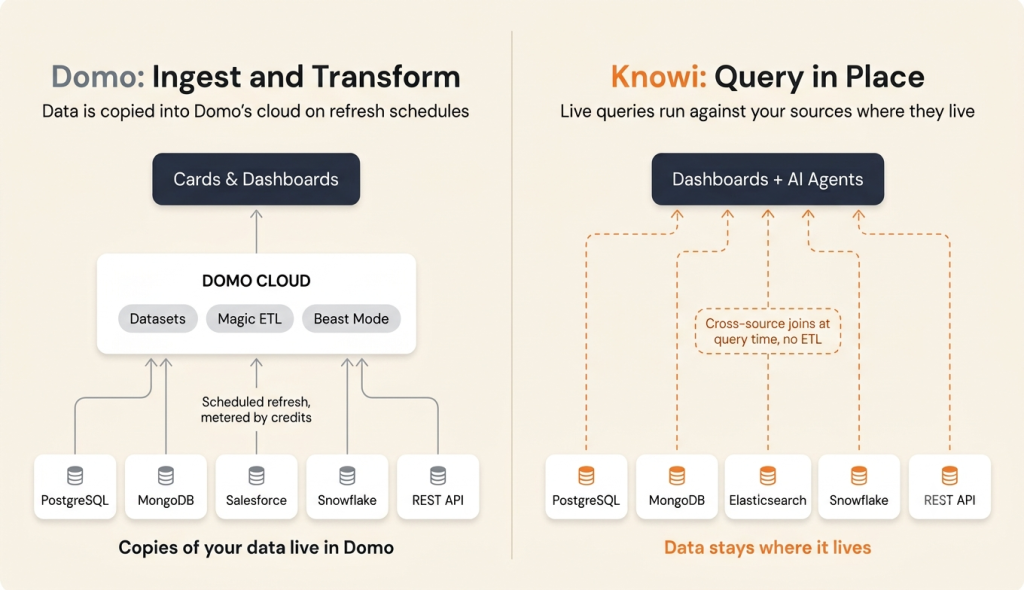
Domo’s model centralizes everything. Connectors pull data into Domo’s cloud on refresh schedules, Magic ETL transforms it into derived datasets, and Beast Mode adds calculated fields on top. It is a genuinely complete pipeline, and for teams without data infrastructure it replaces several tools at once.
Knowi inverts this. Queries run against your sources directly, whether that is PostgreSQL, MongoDB, Elasticsearch, Snowflake, or a REST API, and cross-source joins happen at query time. Nested JSON is handled natively rather than flattened on ingest. The practical difference shows up in freshness (query-time data vs refresh schedules), in cost (no metered ingestion), and in migration weight (no staged copies of your data to maintain).
The honest trade: Domo’s centralized model gives business users a very polished, governed workspace once data is in. Knowi’s federated model suits teams whose data is spread across systems that will not consolidate, especially where NoSQL sources are first-class citizens rather than connector afterthoughts.
AI: Both Serious, Differently Placed
Domo’s AI investment is real. Agent Catalyst lets teams build and govern autonomous agents on Domo’s platform, and AI reaches into the pipeline itself with features like the Text Generation tile in Magic ETL and AI Agent Tasks in Workflows. If your data already lives in Domo, its AI works well on it.
Knowi’s agents operate inside the data layer: they query live sources, build dashboards and reports from natural language, and answer questions across joined sources without a semantic modeling prerequisite. Two differences matter for buyers. Knowi’s NLQ runs on unmodeled, cross-source data, so the AI is useful before a modeling project, not after. And Knowi offers Private AI, running the AI inside your environment for on-prem and VPC deployments, which cloud-only platforms cannot match for regulated workloads.
Head-to-Head Comparison
| Dimension | Domo | Knowi |
|---|---|---|
| Data architecture | Ingests data into Domo cloud datasets on refresh schedules; transforms via Magic ETL | Queries SQL, NoSQL, and REST APIs in place; cross-source joins at query time, no ETL required |
| NoSQL support | Via connectors that load into Domo datasets | Native queries against MongoDB, Elasticsearch, Cassandra, and other NoSQL sources, including nested JSON |
| AI capabilities | Agent Catalyst for building workflow agents; AI features across Magic ETL and Workflows | Agents in the data layer; NLQ on unmodeled cross-source data; dashboard and report generation from natural language |
| AI data privacy | Runs on Domo’s cloud platform | Private AI option: AI runs inside your environment on on-prem and VPC deployments |
| Deployment | Cloud SaaS | Knowi cloud, customer VPC, or on-premise |
| Embedded analytics | Domo Everywhere | White-label, multi-tenant embedded analytics with per-tenant isolation |
| Pricing model | Consumption credits metered on refreshes, transforms, storage, and AI usage; median deals around $50K/yr per Vendr, enterprise $250K+ | Flat annual platform fee, quoted by users and deployment type; no per-query or per-refresh metering |
| Company status (July 2026) | In a sale process; purchase agreement required by July 31, 2026 under lender forbearance | Independent and privately held |
You picked all-in-one for a reason. Keep it.
Moving off one platform should not mean assembling four tools to replace it. Knowi keeps connection, modelling, dashboards, alerting, embedding, and AI in one place, and connects natively to SQL, NoSQL, REST APIs, and documents without an ETL layer in between.
A comparison table only gets you so far. A 30-minute session on your actual sources tells you whether the join you care about works.
Pricing: Credits vs Flat
Domo meters consumption: refreshes, dataflow runs, storage, and AI usage draw from a pre-purchased credit pool, which makes bills track usage patterns rather than headcount. Our Domo pricing guide covers the mechanics and benchmark contract values in detail.
Knowi prices the platform flat for the year, scoped to your deployment. Consumption can favor small, quiet deployments, while flat pricing favors the always-on, heavily scheduled usage that mature BI programs grow into. The difference buyers feel most is forecastability.
Embedded Analytics: Domo Everywhere vs Knowi
Both platforms treat customer-facing analytics as a first-class product, which is rarer than it sounds in this market. Domo Everywhere lets you publish cards and dashboards into external portals and applications, with the same ingestion pipeline underneath, and it inherits Domo’s polish for business-facing consumers.
Knowi’s embedded model is built around white-label, multi-tenant deployments: per-tenant data isolation, full UI theming so the analytics read as your product, and the same cross-source queries serving every tenant without a per-tenant data pipeline. For SaaS companies, the pricing model difference compounds here: embedded usage on consumption credits means your customers’ refresh activity meters your bill, while a flat platform fee makes per-customer analytics costs predictable as you scale.
The practical test for either platform: ask what it takes to onboard tenant number 200. If the answer involves 200 dataset copies or 200 pipelines, that is the real cost of the embed story.
Migrating from Domo to Knowi
The move follows the same shape as any Domo exit, covered fully in our Domo migration guide: datasets export via Domo’s API, while Magic ETL and Beast Mode logic gets rebuilt. The difference with Knowi as the destination is what the rebuild looks like.
Because Knowi joins live sources at query time, a large share of Magic ETL flows do not get rebuilt tile by tile; they get replaced by a single cross-source query against the original systems. Beast Mode calculations become Cloud9QL expressions or AI-generated queries, and Knowi runs migrations as part of onboarding rather than as a paid services engagement. Teams typically parallel-run their top dashboards on live sources within the first weeks, which is the honest way to validate the switch before a renewal decision.
Where Domo Fits Best
Domo remains a strong choice for business-led teams that want one cloud workspace for everything: ingestion, transformation, dashboards, apps, and workflows, with a huge connector library and a polished user experience. Organizations already invested in Magic ETL pipelines and Domo’s app ecosystem get real compounding value from the platform. Our full Domo review covers its strengths in depth.
Where Knowi Fits Best
Knowi fits teams whose data will not consolidate into one cloud: SaaS companies embedding white-label analytics in their product, teams running MongoDB or Elasticsearch alongside SQL, and regulated organizations that need analytics and AI deployed inside their own environment. If you are evaluating an exit from Domo specifically, our Domo migration guide maps what moves and what gets rebuilt.
Which Should You Choose?
Stay on Domo, or wait out the sale, if you are deeply invested in Domo’s app ecosystem and workflows, your credit consumption is stable and governed, and your renewal lands after the ownership question resolves.
Choose Knowi if your data spans SQL, NoSQL, and APIs that will not consolidate, you embed analytics in a product, you need AI and analytics deployable inside your own environment, or credit unpredictability is the reason you are looking. Bring your renewal date: the evaluation is fastest when it runs against your real sources.
Frequently Asked Questions
Is Knowi a direct replacement for Domo?
For dashboards, cross-source analytics, embedded use cases, and AI-driven reporting, yes. Domo’s app-building and workflow automation features do not have one-to-one Knowi equivalents, so teams using those should scope that gap explicitly.
Does Knowi require moving my data like Domo does?
No. Knowi queries your databases and APIs where they live and joins sources at query time. There is no required ingestion step, warehouse, or scheduled copy of your data.
How do Knowi and Domo handle MongoDB differently?
Domo loads MongoDB data into Domo datasets through connectors, flattening it on ingest. Knowi queries MongoDB natively, including nested documents, and can join the results directly with SQL and API sources.
Do both platforms have AI agents?
Yes. Domo’s Agent Catalyst builds and governs agents on its cloud platform, and Knowi runs agents inside the data layer with its own AI. Knowi additionally offers Private AI for on-prem and VPC deployments where data cannot leave the environment.
How does Knowi pricing compare to Domo pricing?
Domo meters consumption credits, with median contracts around $50,000 per year in Vendr’s benchmark data and enterprise deals well above that. Knowi charges a flat annual platform fee with no usage metering, quoted by users and deployment type.
Can Knowi be deployed on-premise?
Yes. Knowi deploys in Knowi’s cloud, in your VPC, or fully on-premise, including its Private AI capability. Domo is available as cloud SaaS.